
Circulation Review Checklist for Toilet Cubicle Door Swing Zones
Quick project answer
Review focus: toilet cubicle.
A toilet cubicle door swing review is a coordination exercise, not a single drawing check. It brings together the layout, the door operation, the support interfaces, the cleaning routine and the applicable local requirements that the project team must confirm. EBUNGE product category includes commercial Toilet Partition / Toilet Cubicle. That confirmed category fact is the starting point; every project-specific material, hardware, dimension, finish, mounting or rating still requires matching approved technical evidence.
This checklist is written for overseas contractors, architects, interior designers, owners, renovation companies, distributors and construction teams. It does not assert compliance, performance or hidden construction. Illustrations show generic design references, not completed EBUNGE customer projects. Use the steps below to structure a review that stays within evidence limits and produces clear questions for the project team.
Why Door Swing Review Belongs in Early Coordination
Project review term: toilet cubicle.
Door swing affects circulation before it affects the cubicle itself. A door that opens into a busy route changes how people move, queue and clean. A door that opens inward changes the usable space inside the cubicle. Neither outcome can be judged from a catalogue image alone.
Early review helps the project team separate fixed constraints from preferences. Fixed constraints may include the room shell, the drainage strategy, the location of other fixtures and the route to the exit. Preferences may include the direction of opening, the position of the latch and the visual line of the door. The review should record which items are confirmed by drawings and which remain open.
What the review can and cannot decide
The review can decide whether the proposed swing fits the drawn circulation zone. The project team should confirm project-specific requirements against the relevant approved technical evidence. It also cannot treat different partition materials as interchangeable. HPL, compact laminate, phenolic and stainless steel are distinct categories and should not be inferred from an illustration.
Checklist: Information to Gather Before the Review
Gather the following items so the discussion is based on documents rather than assumptions. If an item is missing, mark it as an open action instead of filling the gap with a guess.
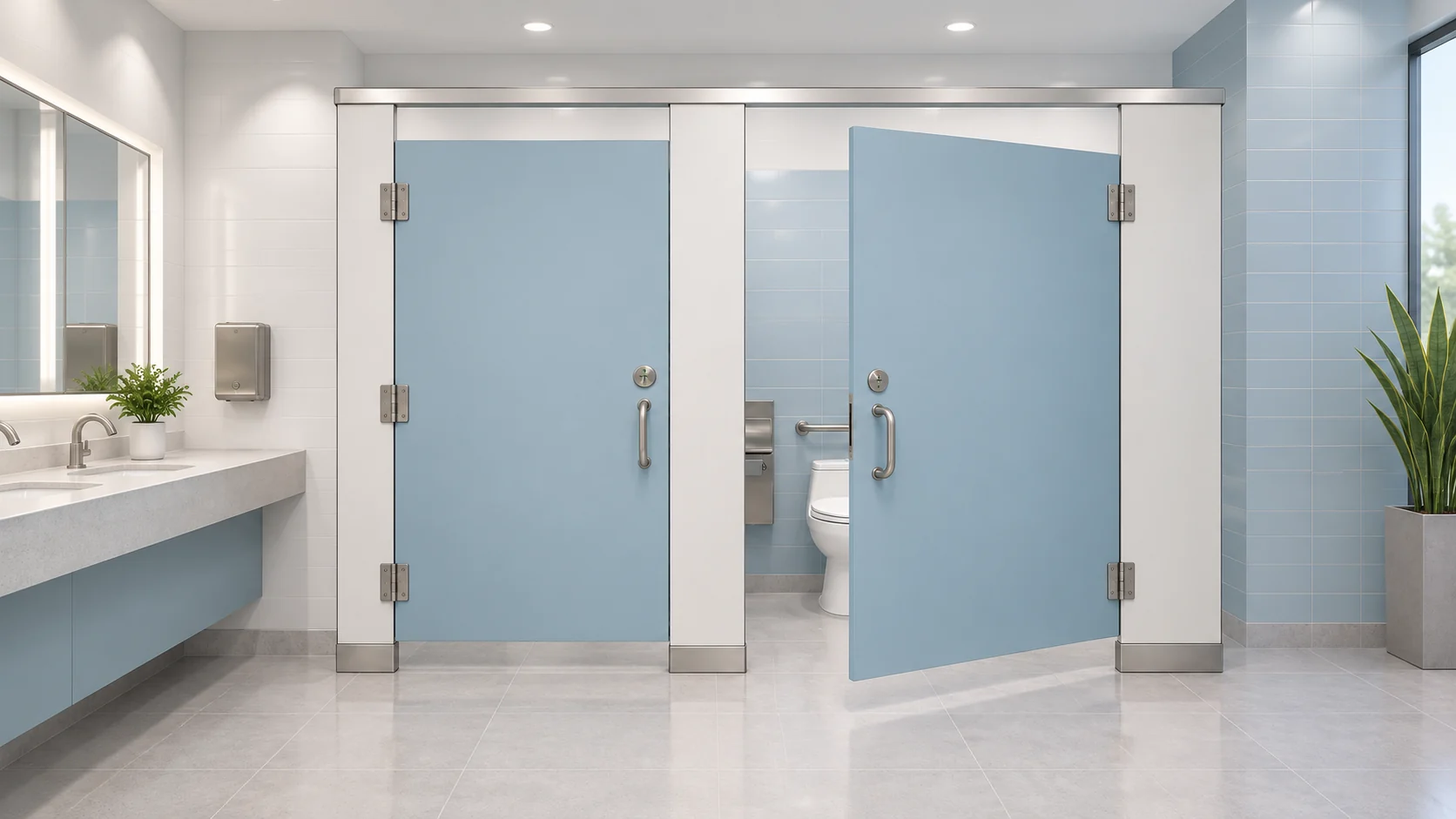
- Current architectural layout showing the cubicle zone and adjacent circulation.
- Door operation intent: inward, outward or another confirmed arrangement.
- Support interface information for the partition and any associated fittings.
- Cleaning documentation describing access and routine methods.
- Applicable local requirements identified by the project team.
- Any approved technical evidence for project-specific materials, hardware, dimensions, finishes, mountings or ratings.
This list is a coordination aid. It does not replace the project specification, and it does not confirm that any item complies with a local code.
Numbered Process for a Structured Door Swing Review
- Confirm the room shell and the drawn circulation route.
- Mark the proposed door leaf position in both open and closed states.
- Check the clearance between the open leaf and any adjacent fixture or wall.
- Review the door operation sequence from the user side and the cleaning side.
- List every support interface that the partition or door relies on.
- Compare the proposed arrangement with the applicable local requirements identified by the project team.
- Record open items and assign an evidence owner for each one.
- Reissue the marked drawing for the next coordination round.
Steps three and four often reveal conflicts that a plan view alone hides. A door may fit on paper but still obstruct a cleaning route or a maintenance access point. The review should note these observations without converting them into performance claims.
Privacy, Door Operation and User Experience
Privacy is a design outcome that depends on the whole cubicle arrangement, not on a single component. The review should consider sightlines from the circulation zone, the position of the door in the closed state and the way the door is operated by different users.
Door operation should be described in plain terms: how it opens, how it closes, how it is secured and how it is released. If the project requires specific hardware, that hardware must be supported by approved technical evidence. Do not infer hidden construction from a generic illustration.
Questions to ask about operation
- Does the door open without conflicting with the drawn circulation route?
- Can a user operate the door comfortably from inside the cubicle?
- Does the closed door support the intended privacy outcome?
- Is the cleaning access route clear when the door is open?
Support Interfaces and Cleaning Documentation
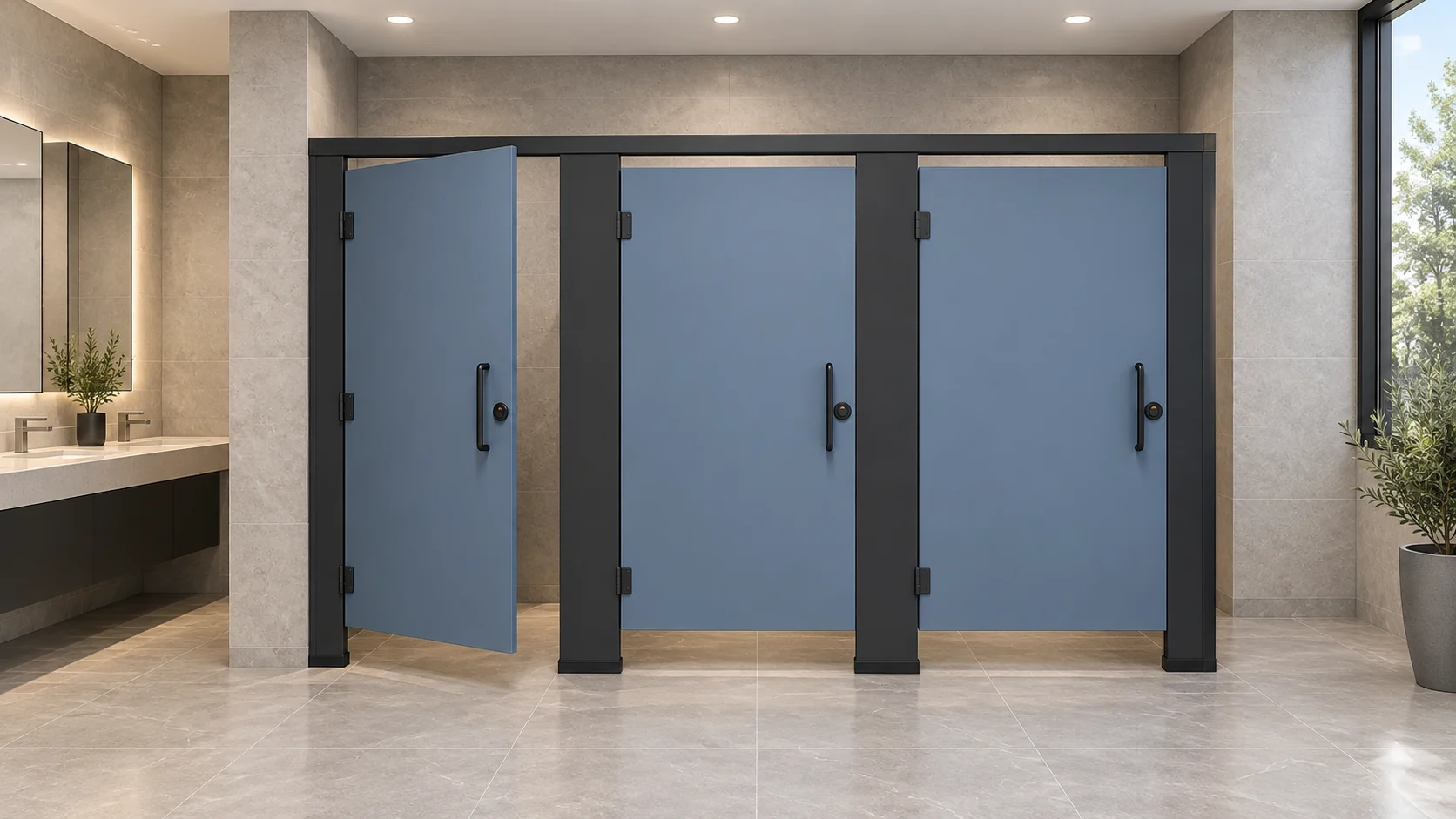
Support interfaces include the points where the partition or door connects to the building structure or to associated fittings. The review should identify each interface and confirm that the responsible party has provided the relevant information. Where information is missing, the item stays open.
Cleaning documentation should describe how the cubicle zone is accessed and maintained. The review can check whether the door swing allows the documented routine to be carried out. It should not claim that a particular material or finish is waterproof, antimicrobial or easy to clean unless that claim is supported by approved technical evidence.
Evidence note
Any project-specific material, hardware, dimension, finish, mounting or rating requires matching approved technical evidence. Illustrations show generic design references, not completed EBUNGE customer projects.
Applicable Local Requirements and Compliance Language
The project team is responsible for identifying the applicable local requirements. The review can describe how the proposed layout relates to those requirements, but it should not assert compliance. Use neutral language such as ‘to be confirmed against the project specification’ rather than ‘meets code’.
Where a requirement affects door swing, record the source and the date it was reviewed.
Documentation and Handover
Keep a marked drawing, a list of open items and a record of the evidence used. The documentation should distinguish between confirmed information and assumptions.
For product category context, see the EBUNGE toilet partition product range. For general guidance material, visit the resources section. When the project team is ready to discuss a specific configuration, use the contact page to start an evidence-based conversation.
FAQ: Toilet Cubicle Door Swing Review
What is the first step in a toilet cubicle door swing review?
Confirm the room shell and the drawn circulation route. Without that baseline, the door swing cannot be assessed against real constraints.
Can the review confirm fire, acoustic or waterproof performance?
No. Those claims require approved technical evidence for the specific configuration. The review can only record what is documented and what remains open.
Are HPL, compact laminate, phenolic and stainless steel interchangeable?
No. They are distinct categories and should not be treated as interchangeable or inferred from an illustration.
How should cleaning documentation be used in the review?
Use it to check whether the door swing allows the documented cleaning routine to be carried out. Do not convert that check into an unverified performance claim.
What should happen when a project-specific dimension is missing?
Mark it as an open item and assign an evidence owner. Do not fill the gap with an assumed dimension.
Does the review replace the project specification?
No. It is a coordination aid. The project specification and applicable local requirements remain the controlling documents.
Conclusion and Next Steps
A disciplined toilet cubicle door swing review keeps the project team focused on layouts, privacy, door operation, support interfaces, cleaning documentation and applicable local requirements. It avoids unsupported conclusions and makes open items visible. EBUNGE product category includes commercial Toilet Partition / Toilet Cubicle, and project-specific details still require matching approved technical evidence.
To move from checklist to coordination, contact the EBUNGE team with your drawings, open items and evidence questions.