
When Should Architects Issue Toilet Partition Hardware Schedules?
Quick project answer
A toilet partition hardware schedule is a coordination document, not a substitute for approved project drawings or product data. Architects and project teams often ask when it should be issued. The honest answer depends on design maturity, procurement route and the evidence available for each cubicle type. EBUNGE product category includes commercial Toilet Partition / Toilet Cubicle. This article sets out a review framework for overseas contractors, architects, interior designers, owners and renovation teams. It does not confirm compliance, performance or project-specific configuration. Every material, hardware item, dimension, finish, mounting condition and rating must be matched to approved technical evidence before it is treated as final.
What a Toilet Partition Hardware Schedule Is Meant to Coordinate
A hardware schedule typically lists the items associated with each cubicle or compartment, such as hinges, latches, keepers, indicators, foot assemblies and support interfaces. It connects the architectural layout to the procurement and installation sequence. It is not a product catalogue and it is not a performance certificate.
For project teams, the schedule is most useful when it references the approved drawings, the selected partition system and the confirmed interface conditions. If any of those inputs are still open, the schedule should be marked as preliminary. That status protects the team from treating an early coordination draft as a construction instruction.
Schedule inputs that usually need confirmation
- Approved layout drawings showing cubicle positions and door swings.
- Confirmed partition system and material selection, supported by project-specific evidence.
- Door operation requirements, including privacy and accessible-use considerations.
- Support interface conditions at walls, floors and any structural connections.
- Cleaning and maintenance documentation expectations for the facility.
- Applicable local requirements identified by the project team.
When the Schedule Should Be Issued
There is no single issue date that fits every project. The right moment is when the design has enough confirmed information to allow meaningful coordination, but before procurement locks in items that cannot be changed. Issuing too early creates a document full of assumptions. Issuing too late creates pressure to substitute or rush approvals.
A practical approach is to issue the schedule in stages. A preliminary issue can support budgeting and layout review. A coordinated issue can follow once the partition system and interface conditions are confirmed. A final issue should align with approved technical evidence and the construction programme.
Stage-based issue points
- Concept and layout stage: issue a preliminary schedule only if it is clearly marked as indicative and not for procurement.
- Design development: update the schedule as door operation, privacy and support interfaces are reviewed.
- Pre-tender or pre-order: confirm that every listed item has matching approved evidence.
- Construction issue: release the final schedule with the approved drawings and installation information.
- Post-installation review: record any as-built changes and close out documentation.
Evidence Boundaries Every Reviewer Should Apply
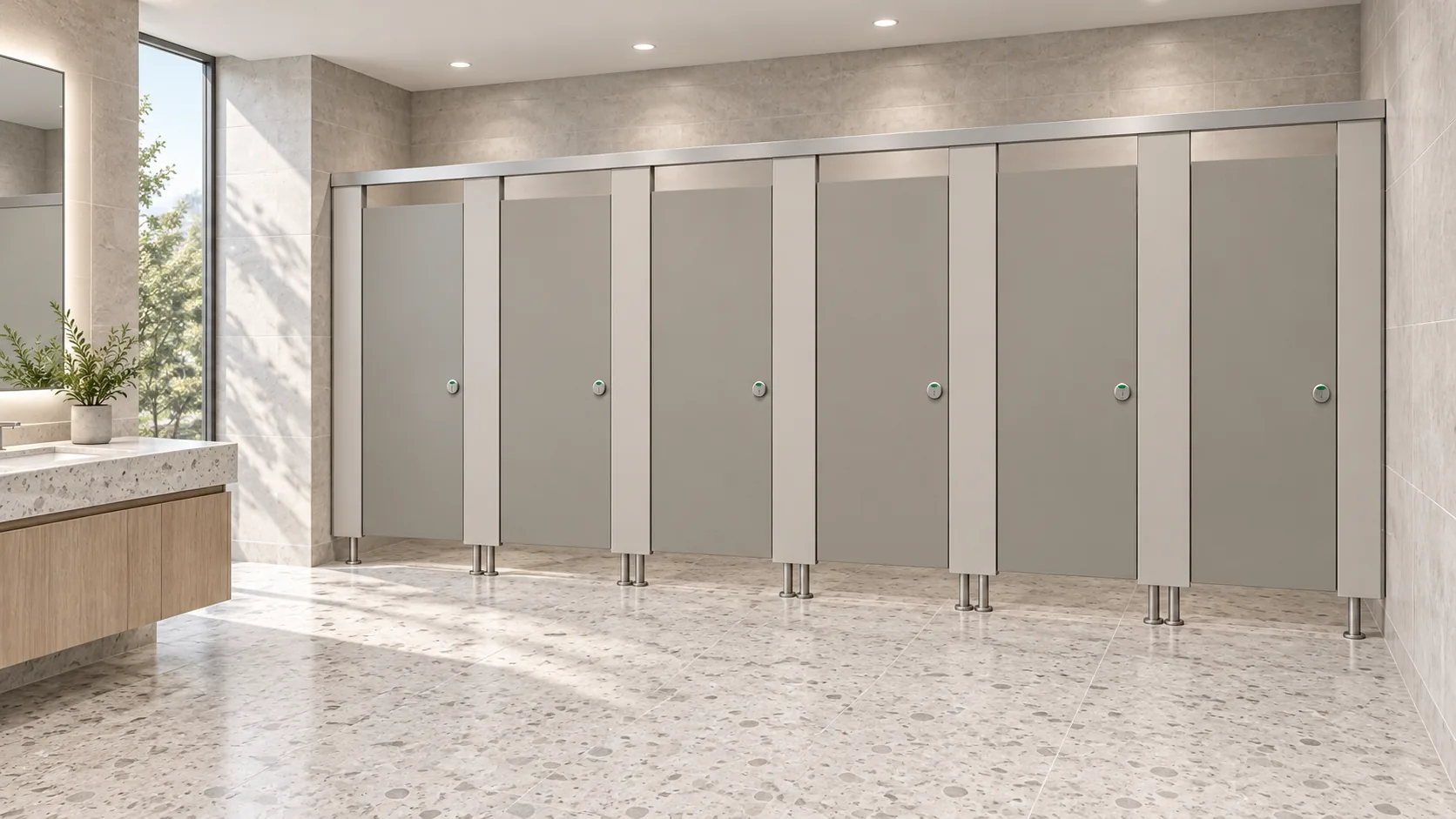
Project teams should separate confirmed facts from assumptions. EBUNGE product category includes commercial Toilet Partition / Toilet Cubicle. That is a category statement, not a project-specific confirmation. The project team should confirm project-specific requirements against the relevant approved technical evidence.
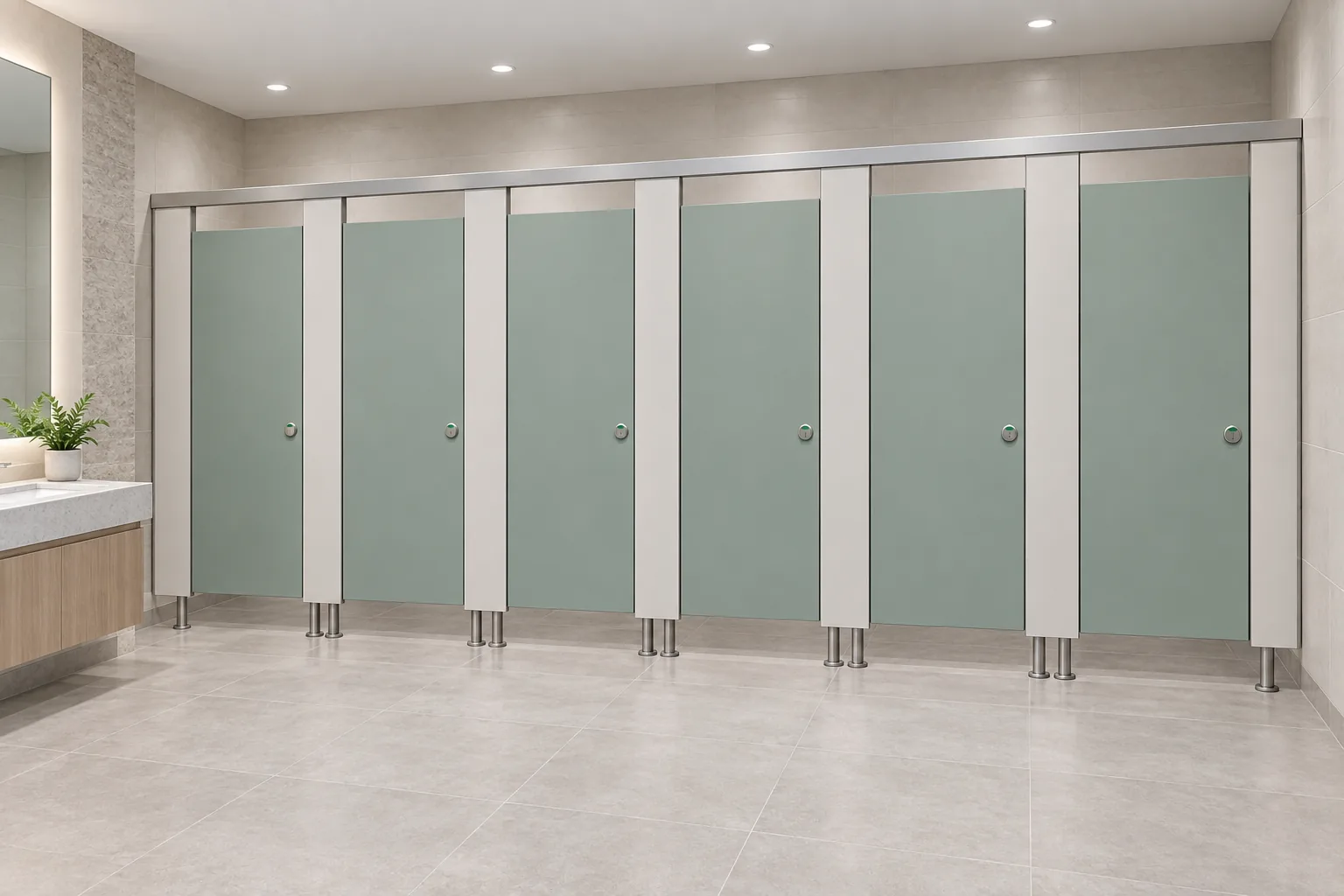
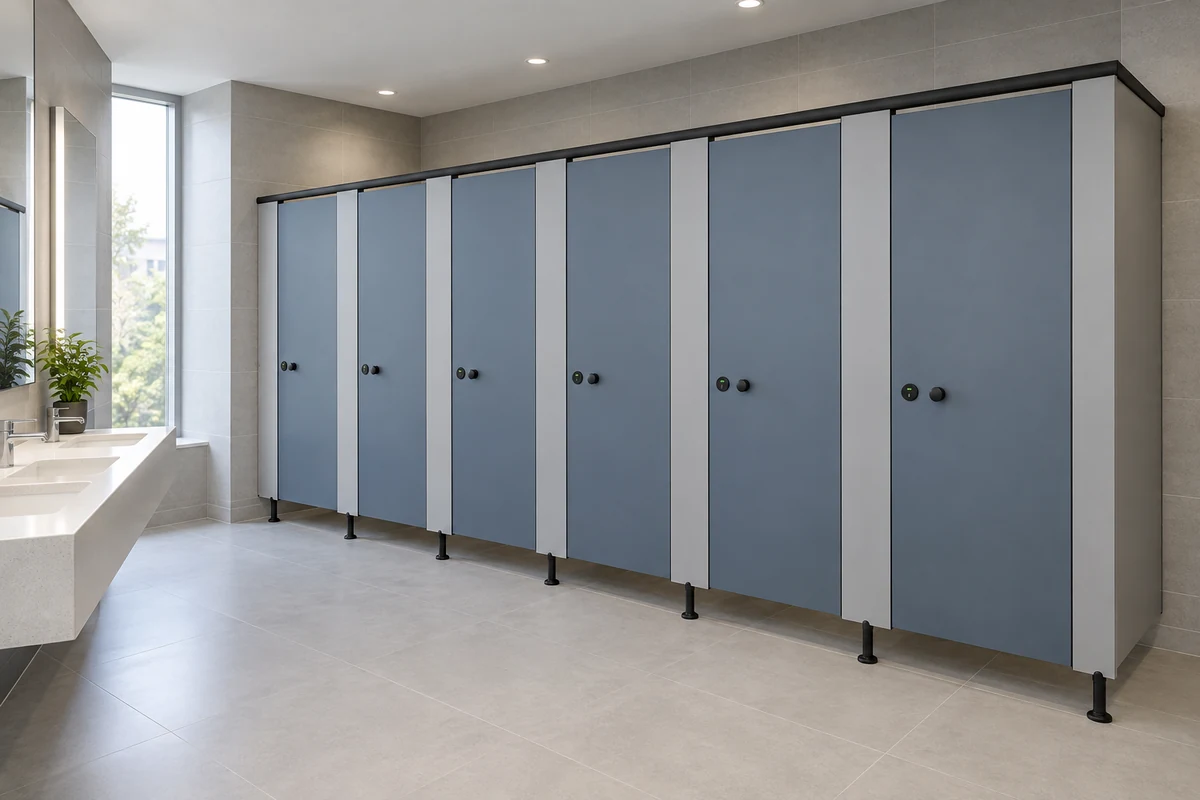
Illustrations and generic references show design intent only. They are not completed EBUNGE customer projects and should not be used to infer hidden construction. HPL, compact laminate, phenolic and stainless steel are not interchangeable descriptions. A schedule should name the selected system only when the project evidence supports that selection.
Evidence note: Any project-specific material, hardware, dimension, finish, mounting or rating requires matching approved technical evidence. If that evidence is not available, keep the item open and mark the schedule as preliminary.
How to Coordinate the Schedule Across Disciplines
Hardware scheduling touches architecture, interiors, structural interfaces, mechanical and electrical services, and the installation team. Each discipline may hold part of the information needed to confirm an item. Coordination is therefore a review process, not a single handover.
Architects can lead by defining what must be confirmed and by recording open items. Contractors can check buildability and sequence. Owners and facility teams can confirm cleaning and maintenance expectations. Distributors and suppliers can provide product documentation for the selected system, but they should not be asked to fill gaps with assumptions.
Coordination checklist for project meetings
- Are the approved layout drawings the current revision?
- Is the partition system selection confirmed with project-specific evidence?
- Are door operation and privacy requirements reviewed against the layout?
- Are support interfaces coordinated with adjacent construction?
- Are cleaning and maintenance documents identified for handover?
- Are applicable local requirements listed and assigned to a responsible party?
- Are all open items recorded with an owner and a due date?
Common Mistakes That Delay Approval
One common mistake is treating a generic illustration as a construction detail. Another is listing hardware items without linking them to the approved partition system. A third is issuing a schedule without a clear revision status, which makes it difficult to know whether the document is for coordination or for order.
Teams also lose time when they assume that a material name alone answers performance questions. It does not. The schedule should point to that evidence rather than replace it.
Review questions before issuing
| Review area | Question to resolve | Status if unresolved |
|---|---|---|
| Layout | Are cubicle positions and door swings approved? | Preliminary |
| System selection | Is the partition system confirmed with evidence? | Open |
| Door operation | Are privacy and operation requirements reviewed? | Open |
| Support interfaces | Are wall and floor conditions coordinated? | Open |
| Cleaning documentation | Are maintenance expectations recorded? | Open |
| Local requirements | Has the project team identified applicable rules? | Open |
How This Fits the EBUNGE Product Category
EBUNGE product category includes commercial Toilet Partition / Toilet Cubicle. Project teams can use the product overview to understand the category and then request project-specific documentation for the selected configuration. The resources section can support general planning, but it does not replace approved drawings or technical evidence.
When the schedule is ready for review, the project team should confirm the exact items, finishes and interfaces with the relevant supplier. If information is missing, the correct action is to keep the item open rather than infer a value. This discipline protects the design intent and reduces the risk of rework.
FAQ: Toilet Partition Hardware Schedule Planning
When should architects first issue a toilet partition hardware schedule?
Issue a preliminary schedule when the layout is stable enough for coordination, but mark it clearly as not for procurement. The final issue should wait until the partition system, door operation, support interfaces and applicable local requirements have matching approved evidence.
What information is required before the schedule can be finalised?
Finalisation requires approved layout drawings, a confirmed partition system with project-specific evidence, reviewed door operation and privacy requirements, coordinated support interfaces, cleaning documentation expectations and a list of applicable local requirements.
Can a generic illustration be used as a hardware schedule reference?
Generic illustrations show design intent only. They are not completed EBUNGE customer projects and should not be used to infer hidden construction, dimensions, materials or performance. Use them for discussion, then confirm every item with approved project evidence.
How should the schedule handle materials such as HPL or stainless steel?
Do not treat HPL, compact laminate, phenolic or stainless steel as interchangeable. Each selection must be supported by project-specific evidence for the intended application. The schedule should name the confirmed system rather than assume equivalence.
Who should review the schedule before it is issued?
The review should involve the architect, contractor, relevant engineering disciplines, the owner or facility representative, and the selected supplier. Each party confirms the items within its responsibility and records any open points with an owner and due date.
What should happen if project evidence is missing?
Keep the affected item open and mark the schedule as preliminary. Do not fill the gap with an assumed dimension, rating, finish or performance value. Request the missing documentation and update the schedule once it is available.
Conclusion: Issue When Evidence Supports Coordination
Early issues should be clearly preliminary. Final issues should follow confirmation of layout, door operation, support interfaces, cleaning documentation and applicable local requirements. This approach keeps the schedule useful without turning it into an unsupported performance claim.
To discuss a project or request the documentation needed for your review, contact the EBUNGE team. Share your approved drawings, selected system and open questions so the response can be matched to your project rather than to a generic assumption.