
How to Benchmark Toilet Partition Hardware Pricing in Tender Reviews
Quick answer: toilet partition
Toilet partition hardware tender pricing is rarely a single number. It is a bundle of scope, interfaces and evidence that project teams must compare on equal terms. For overseas contractors, architects, interior designers, owners and renovation teams, the goal is not to find the lowest figure but to understand what each submission actually covers. EBUNGE product category includes commercial Toilet Partition / Toilet Cubicle.
That confirmed fact is the starting point, not a substitute for project-specific evidence. This guide sets out a review framework that keeps pricing discussions tied to maintained product facts, visible evidence limits and drawing review.
Why Tender Pricing Reviews Fail Before They Start
Most pricing disputes begin with mismatched assumptions. One bidder may price a layout based on a generic reference, while another prices a different door operation or support interface. Neither is wrong until the tender documents define the scope. The review team should separate what is confirmed from what is assumed.
Planning boundaries matter here. Any project-specific material, hardware, dimension, finish, mounting or rating requires matching approved technical evidence. Without that evidence, a price line is only a placeholder. The review should flag placeholders rather than treat them as comparable.
Build a Scope Baseline Before Comparing Numbers
A scope baseline is a written summary of what the tender asks each bidder to price. It should reference the layout, privacy expectations, door operation, support interfaces and cleaning documentation. It should also note applicable local requirements without asserting unverified compliance.
The baseline does not need to be long. It needs to be specific enough that two reviewers reading it would price the same scope. Where the design is still developing, mark the item as open and require a clarification path.
Information to collect from the project team
- Layout drawings showing cubicle positions and circulation.
- Door operation description, including swing or access expectations.
- Support interface notes for walls, floors and adjacent construction.
- Cleaning documentation expectations for the finished installation.
- Applicable local requirements identified by the project team.
- Any approved technical evidence already issued for the project.
Separate Product Facts from Project Assumptions
EBUNGE product category includes commercial Toilet Partition / Toilet Cubicle. That is a confirmed product fact. It does not confirm a material composition, dimension, finish, rating or hardware set for a specific project. Reviewers should keep that distinction visible in every pricing comparison.
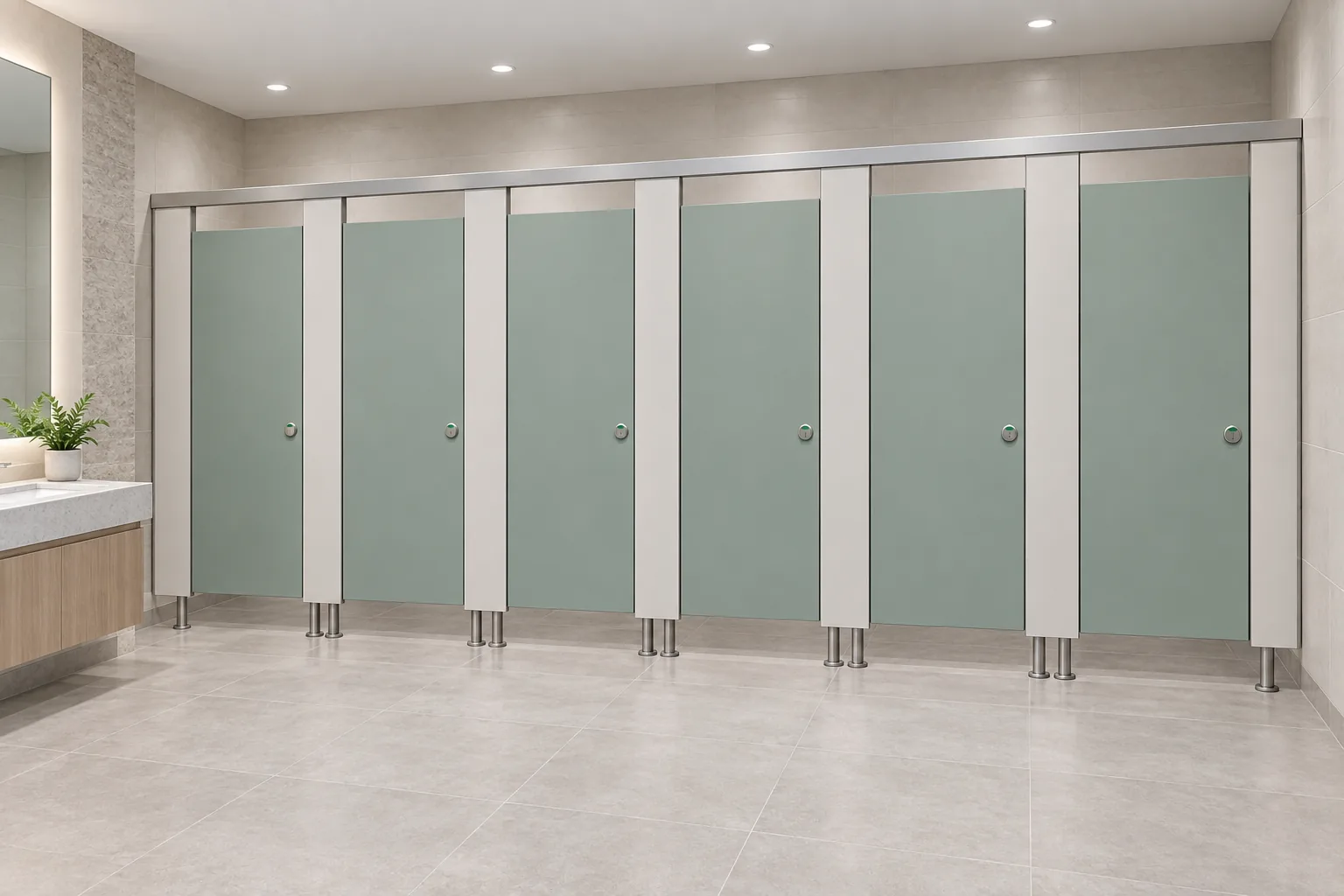
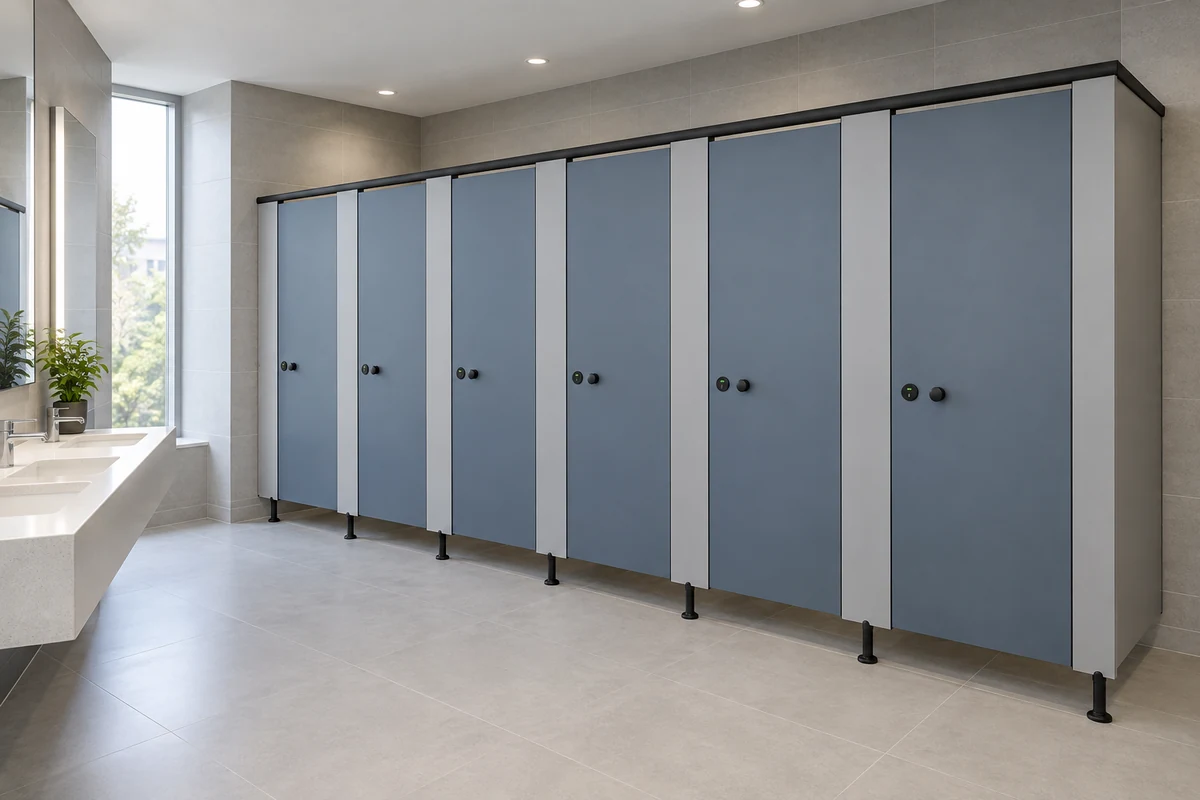
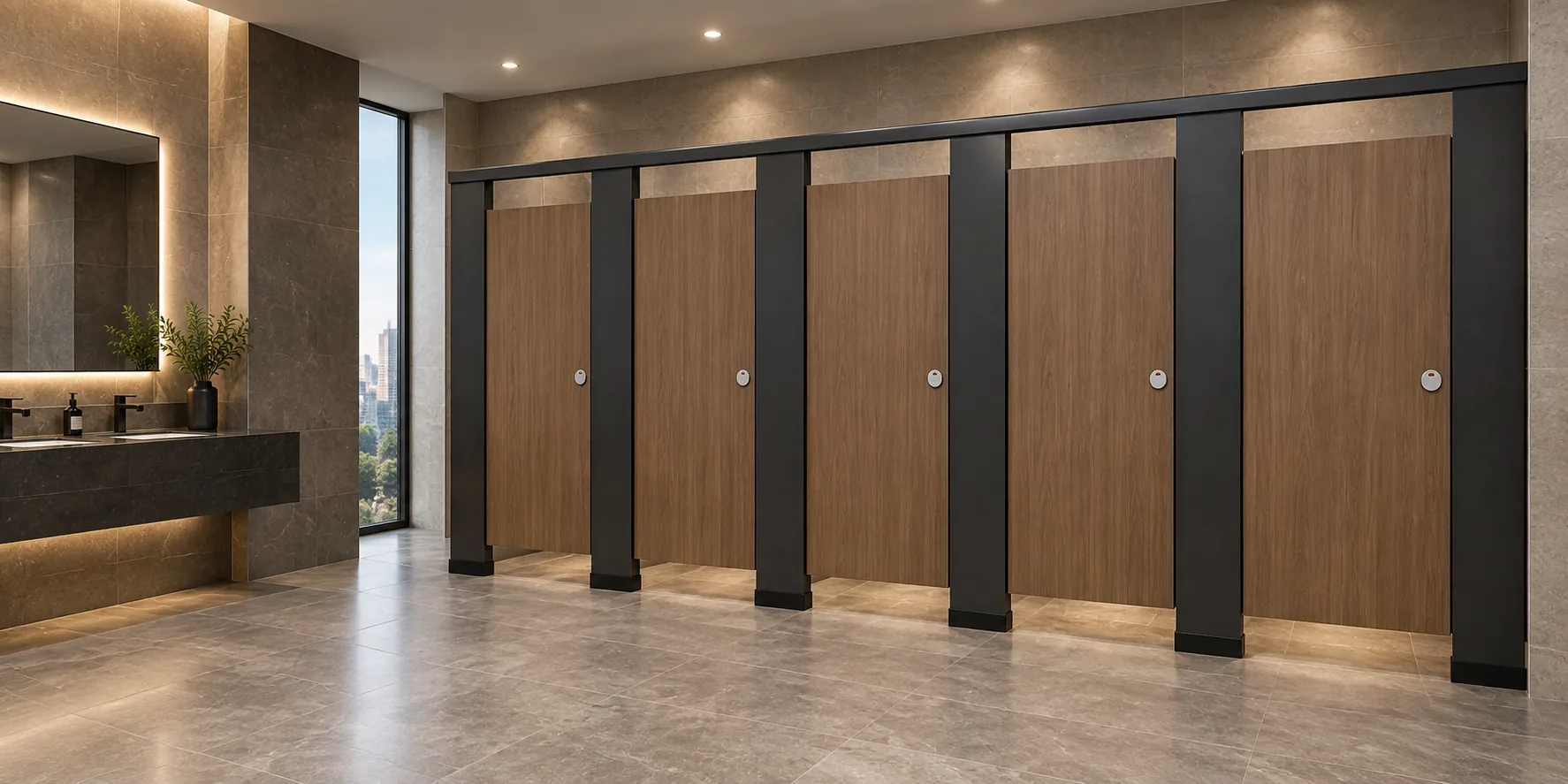
Do not treat HPL, compact laminate, phenolic or stainless steel as interchangeable. Do not infer hidden construction from illustrations. Illustrations show generic design references, not completed EBUNGE customer projects. When a bidder references a material or hardware detail, ask for the matching approved technical evidence.
Evidence note for reviewers
If a pricing line depends on a material, hardware, dimension, finish, mounting or rating that is not supported by approved technical evidence, record it as an open item. Do not average it into the benchmark until the evidence is supplied.
A Numbered Process for Benchmarking Submissions
Use a repeatable process so that each submission is reviewed the same way. The steps below are designed for a project team that includes commercial, technical and operations reviewers.
- Confirm the scope baseline and issue it to all bidders.
- Check that each submission responds to every baseline item.
- Separate confirmed product facts from project-specific assumptions.
- Request missing approved technical evidence before scoring price.
- Normalise inclusions such as delivery, documentation and site support only where the tender defines them.
- Compare remaining differences in a written clarification log.
- Escalate unresolved items to the project team for a decision.
This process does not produce a single benchmark figure. It produces a defensible comparison. That is more useful in a tender review than a number that hides scope gaps.
Compare Submissions with a Structured Checklist
A compact comparison table helps the review team see where submissions align and where they diverge. The table below uses neutral categories. It does not imply that any material or hardware option is equivalent to another.
| Review category | What to check | Evidence required |
|---|---|---|
| Scope coverage | All baseline items addressed | Written response |
| Layout and privacy | Alignment with project drawings | Approved drawing set |
| Door operation | Description matches tender intent | Project-specific detail |
| Support interfaces | Wall, floor and adjacent conditions noted | Interface notes |
| Cleaning documentation | Maintenance information included | Documentation list |
| Local requirements | Identified by project team | Applicable local reference |
Use the table as a discussion tool, not as a scoring formula. The project team should decide which categories are critical for the specific building.
Coordinate Across Disciplines Without Overclaiming
Toilet partition hardware tender pricing touches several disciplines. The architect may focus on layout and privacy. The contractor may focus on support interfaces and sequencing. The owner may focus on cleaning documentation and long-term operation. The distributor may focus on availability and documentation.
The project team should confirm project-specific requirements against the relevant approved technical evidence. A clarification log should record who owns each open item and what evidence is needed to close it. This avoids the common mistake of treating a provisional price as a final commitment.
Questions to ask before accepting a benchmark
- Does the submission reference approved technical evidence for every project-specific item?
- Are layout, privacy and door operation described consistently with the tender drawings?
- Are support interfaces and cleaning documentation addressed in writing?
- Have applicable local requirements been identified without claiming compliance?
- Are all remaining assumptions listed as open items?
Document the Review for Future Tenders
A well-documented review becomes a reference for later projects. Keep the scope baseline, clarification log and evidence notes together. Record which items were confirmed and which remained open. This helps future tender teams avoid repeating the same assumptions.
For product category context, see the EBUNGE product overview. For general guidance, visit the resources section. When your project team is ready to discuss a specific scope, contact EBUNGE with your drawings and evidence requirements.
Frequently Asked Questions
What is toilet partition hardware tender pricing?
It is the priced scope submitted by a bidder for the hardware and related components of a toilet partition installation. The price should be read together with the scope baseline, project drawings and approved technical evidence.
Can I compare prices without approved technical evidence?
You can compare the numbers, but the comparison may be misleading. Any project-specific material, hardware, dimension, finish, mounting or rating requires matching approved technical evidence before it can be treated as a like-for-like item.
Does EBUNGE confirm material or performance ratings in this article?
No. EBUNGE product category includes commercial Toilet Partition / Toilet Cubicle.
How should the project team handle local requirements?
The project team should identify applicable local requirements and describe how they will be reviewed. This article does not assert unverified compliance. Compliance claims require project-specific evidence and local verification.
Are the illustrations in this article completed EBUNGE projects?
No. Illustrations show generic design references, not completed EBUNGE customer projects. They are intended to support discussion of layout and review concepts.
What should be included in a clarification log?
Record each open item, the evidence required, the responsible party and the date.
Conclusion and Next Step
Benchmarking toilet partition hardware tender pricing is an evidence discipline. Start with a scope baseline, separate confirmed product facts from project assumptions, and require approved technical evidence for every project-specific item. Use a structured checklist and a clarification log to keep the review transparent. Do not treat materials as interchangeable or infer hidden construction from illustrations.
When your team is ready to review a specific project, contact EBUNGE with your drawings, scope baseline and evidence requirements. The project team can then coordinate layout, privacy, door operation, support interfaces, cleaning documentation and applicable local requirements on a clear factual basis.