
Toilet Partition Hardware Design Phase Coordination
Quick project answer
Review focus: toilet partition.
Toilet partition hardware design phase coordination is the discipline of aligning cubicle layouts, door operation, support interfaces and cleaning documentation with the evidence available at each design stage. Architects rarely control every hardware decision alone. They coordinate a chain of project-team reviews that moves from concept to construction documentation, then into procurement and installation. This article sets out a phase-by-phase framework for that coordination.
It does not assert compliance, performance or product capability. Every project-specific material, hardware, dimension, finish, mounting or rating requires matching approved technical evidence before it is treated as confirmed.
Why Hardware Coordination Belongs in the Design Programme
Hardware is often treated as a late procurement detail. In practice, door operation, privacy, support interfaces and cleaning routines all influence early planning. The project team should confirm project-specific requirements against the relevant approved technical evidence.
Coordination does not mean specifying a product early. It means recording what is known, what is assumed and what still requires evidence. That record becomes the basis for drawing review and later procurement conversations.
Phase 1: Concept and Feasibility Review
At concept stage, the project team reviews layout intent, user groups, privacy expectations and the applicable local requirements that will govern the design. No hardware selection should be presented as final here.
What to record at concept stage
- Room geometry and cubicle count as a planning assumption, not a confirmed dimension.
- Door operation intent, such as inward or outward swing, subject to later review.
- Support interface questions, including wall, floor and ceiling conditions to be verified.
- Cleaning documentation needs and who will maintain the installation.
- Local requirements that the project team must confirm with the relevant authority.
These items are questions, not conclusions. They give the team a shared list to close out in later phases.
Phase 2: Schematic Design and Layout Coordination
Schematic design is where layout and hardware begin to interact. The team reviews cubicle dimensions, door positions, circulation and privacy together rather than in isolation.
Coordination checklist for schematic design
- Confirm the cubicle layout against the architectural grid and adjacent services.
- Review door operation and clearance with the wider circulation strategy.
- List any hardware items that require project-specific evidence.
- Flag assumptions that must be resolved before tender.
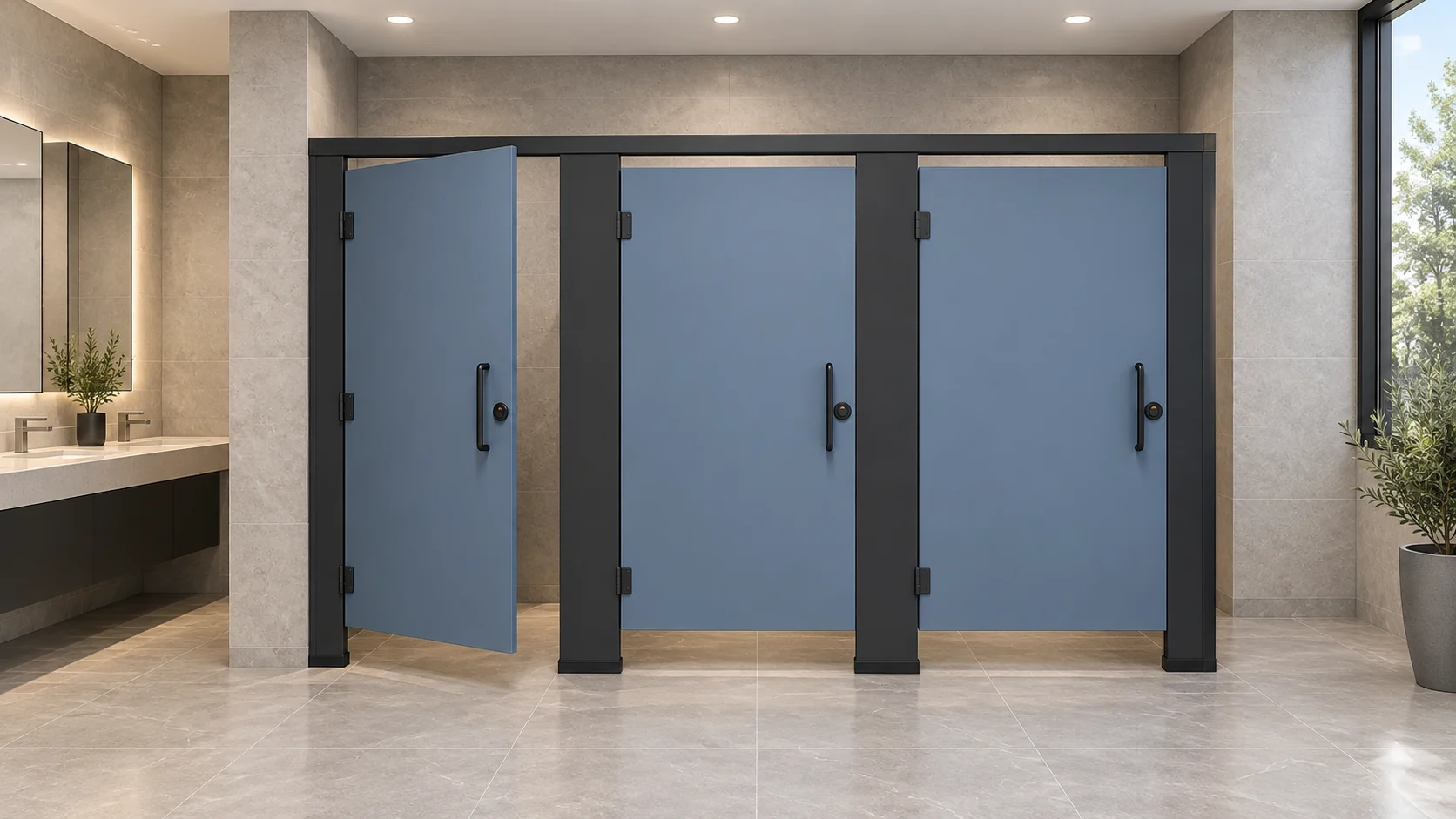
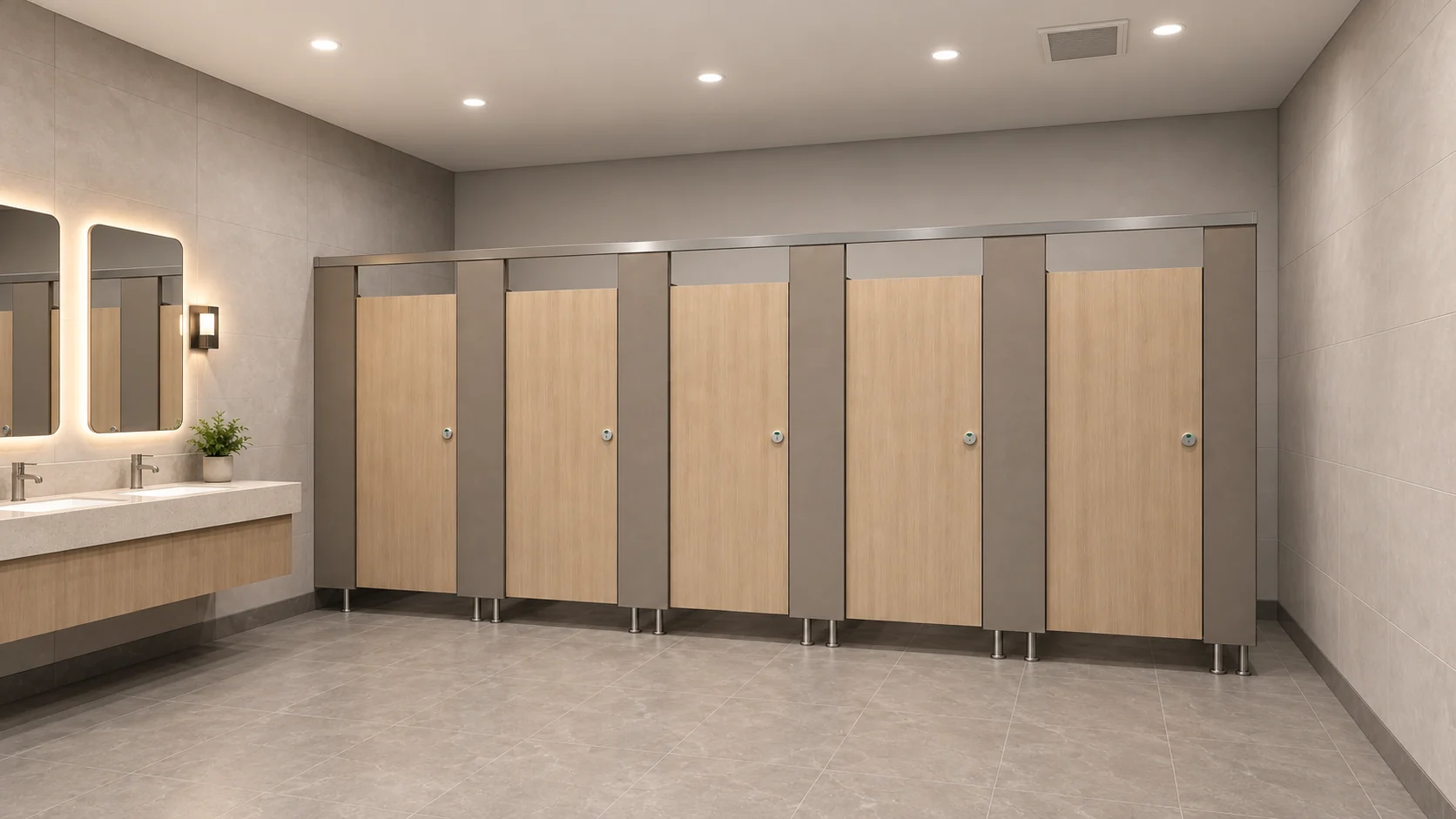
At this stage, the team should avoid treating HPL, compact laminate, phenolic or stainless steel as interchangeable. Each material family carries different implications, and none should be inferred from an illustration.
Phase 3: Design Development and Evidence Mapping
Design development is the point at which assumptions must be matched to evidence. The project team should map each hardware decision to a source: a maintained product fact, an approved technical document, or a project-specific confirmation.
Evidence note
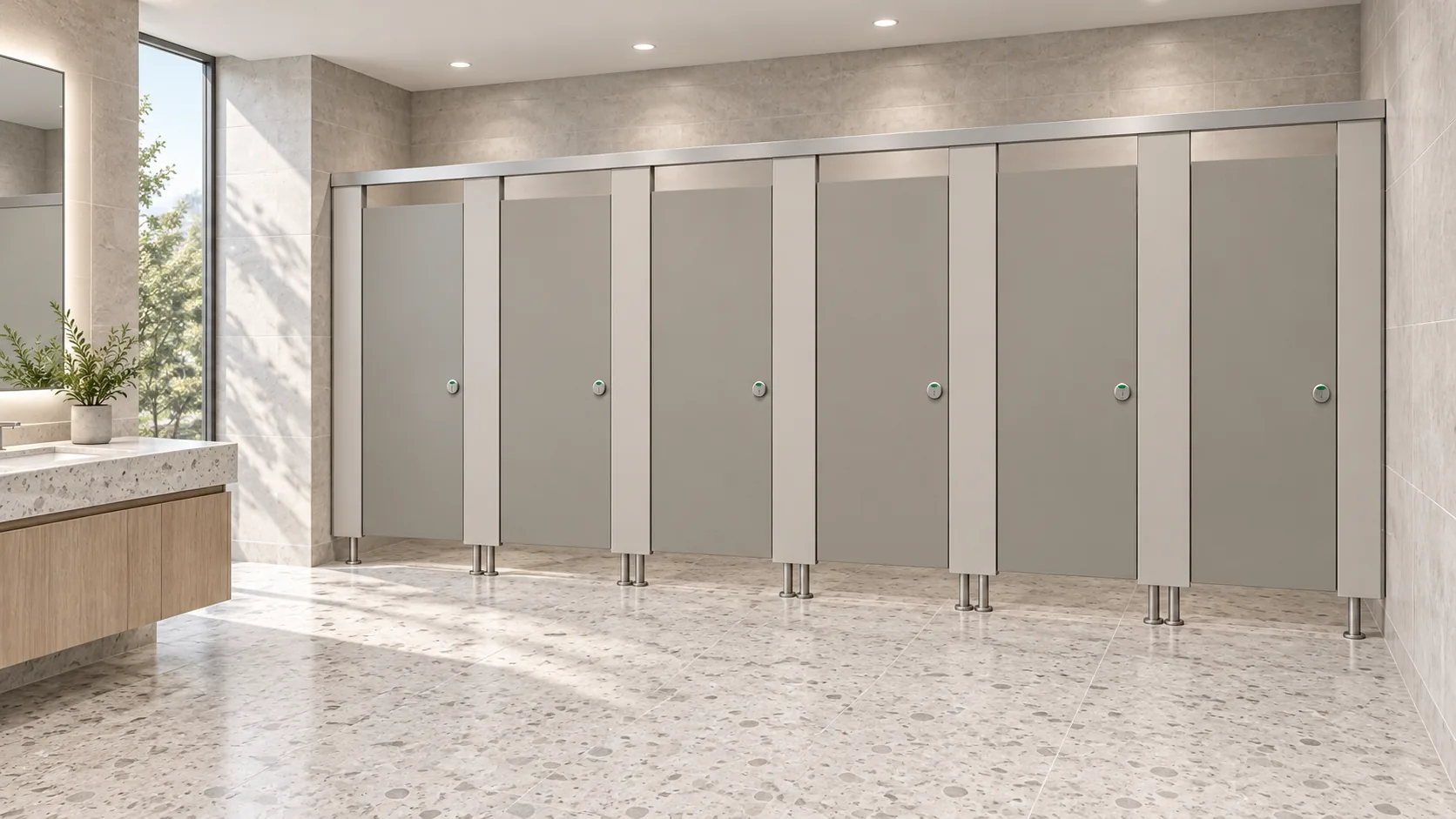
Illustrations show generic design references, not completed EBUNGE customer projects. Any project-specific material, hardware, dimension, finish, mounting or rating requires matching approved technical evidence. Where evidence is not yet available, the item remains an open coordination point.
This discipline prevents a common failure: a drawing note that reads as a confirmed specification when it is still an assumption. The team should keep a live register of open items and close them before construction documentation is issued.
Phase 4: Construction Documentation and Tender
Construction documentation translates coordinated decisions into drawings and schedules. Hardware coordination here means checking that every referenced item has a matching evidence source and that no performance claim is implied without support.
Compact comparison of coordination focus by phase
| Phase | Primary coordination focus | Evidence status |
|---|---|---|
| Concept | Layout intent, privacy, local requirements | Assumptions recorded |
| Schematic design | Door operation, support interfaces, circulation | Open items listed |
| Design development | Material and hardware mapping | Evidence matched or flagged |
| Construction documentation | Drawing review, schedules, tender queries | Confirmed items only |
| Installation and handover | Cleaning documentation, maintenance access | Project-specific confirmation |
The table is a planning aid, not a compliance statement. Applicable local requirements remain a project-team responsibility.
Phase 5: Installation, Handover and Cleaning Documentation
Installation is where coordination is tested. The team should verify that support interfaces match the approved drawings and that door operation performs as reviewed. Cleaning documentation should be handed over in a form the maintenance team can use.
Handover is also the point to confirm that no unverified performance claim has entered the record. If a query arises about a rating, warranty or service life, it must be answered with approved evidence, not inference.
Common Coordination Gaps and How to Close Them
Most gaps fall into predictable categories. Naming them helps the project team close them earlier.
- Hardware referenced in drawings without a matching evidence source.
- Door operation assumed but not reviewed with the wider circulation strategy.
- Support interfaces left to the installer without structural or MEP input.
- Cleaning documentation omitted from the handover pack.
- Local requirements treated as confirmed without authority review.
Each gap can be closed by assigning an owner and a review date. The goal is not to eliminate uncertainty but to make it visible and managed.
FAQ: Toilet Partition Hardware Design Phase Coordination
What information does a project team need before coordinating toilet partition hardware?
The team needs layout intent, user groups, privacy expectations, door operation intent, support interface conditions and the applicable local requirements to be confirmed. These are planning inputs, not confirmed product facts.
Can an architect specify hardware from an illustration?
No. Illustrations show generic design references, not completed EBUNGE customer projects. Any project-specific material, hardware, dimension, finish, mounting or rating requires matching approved technical evidence.
How should the team treat HPL, compact laminate, phenolic and stainless steel?
They should not be treated as interchangeable. Each material family has its own implications, and none should be inferred from an illustration or substituted without project-specific evidence.
When should cleaning documentation be coordinated?
Cleaning documentation should be planned during design development and confirmed at handover. It should describe the routines the maintenance team will follow, without asserting unverified performance.
What should happen if a performance question arises during tender?
The question should be answered with approved technical evidence. If evidence is not available, the item remains open and should not be presented as a confirmed capability.
Does EBUNGE provide project-specific hardware confirmation?
EBUNGE product category includes commercial Toilet Partition / Toilet Cubicle. Project-specific material, hardware, dimension, finish, mounting or rating requires matching approved technical evidence. The project team should confirm requirements through the appropriate channel.
Conclusion: Coordination as an Evidence Discipline
Toilet partition hardware design phase coordination is less about selecting a product early and more about managing evidence across phases. Concept and schematic design record assumptions. Design development maps them to evidence. Construction documentation confirms only what is supported. Installation and handover close the loop with cleaning documentation and maintenance access.
Architects and project teams who follow this discipline reduce the risk of unsupported claims entering the record. They also give contractors and distributors a clearer basis for procurement conversations. For maintained product context, review the EBUNGE product range and the resource library. When your project is ready to discuss requirements, contact the EBUNGE team to confirm the evidence needed for your specific configuration.