
What to Verify in Toilet Partition Hardware Tender Schedules
Quick project answer
A toilet partition hardware tender schedule is not a catalogue extract. It is a coordination document that should let contractors, architects, owners and distributors compare what is actually specified, what remains open, and which project-specific evidence is still missing. For commercial Toilet Partition / Toilet Cubicle work, the schedule often sits between architectural intent and site installation. That position makes it vulnerable to assumptions about materials, hardware, dimensions, finishes and ratings. This guide sets out a review framework that keeps every recommendation tied to maintained product facts, visible evidence limits and project-specific drawing review.
Why the Tender Schedule Needs an Evidence Boundary
A tender schedule can look complete while still containing unresolved items. A line may name a cubicle type without confirming the supporting interface, door operation or cleaning method. Another line may imply a performance level without an approved test reference. The safe approach is to separate confirmed product-category facts from project-specific requirements.
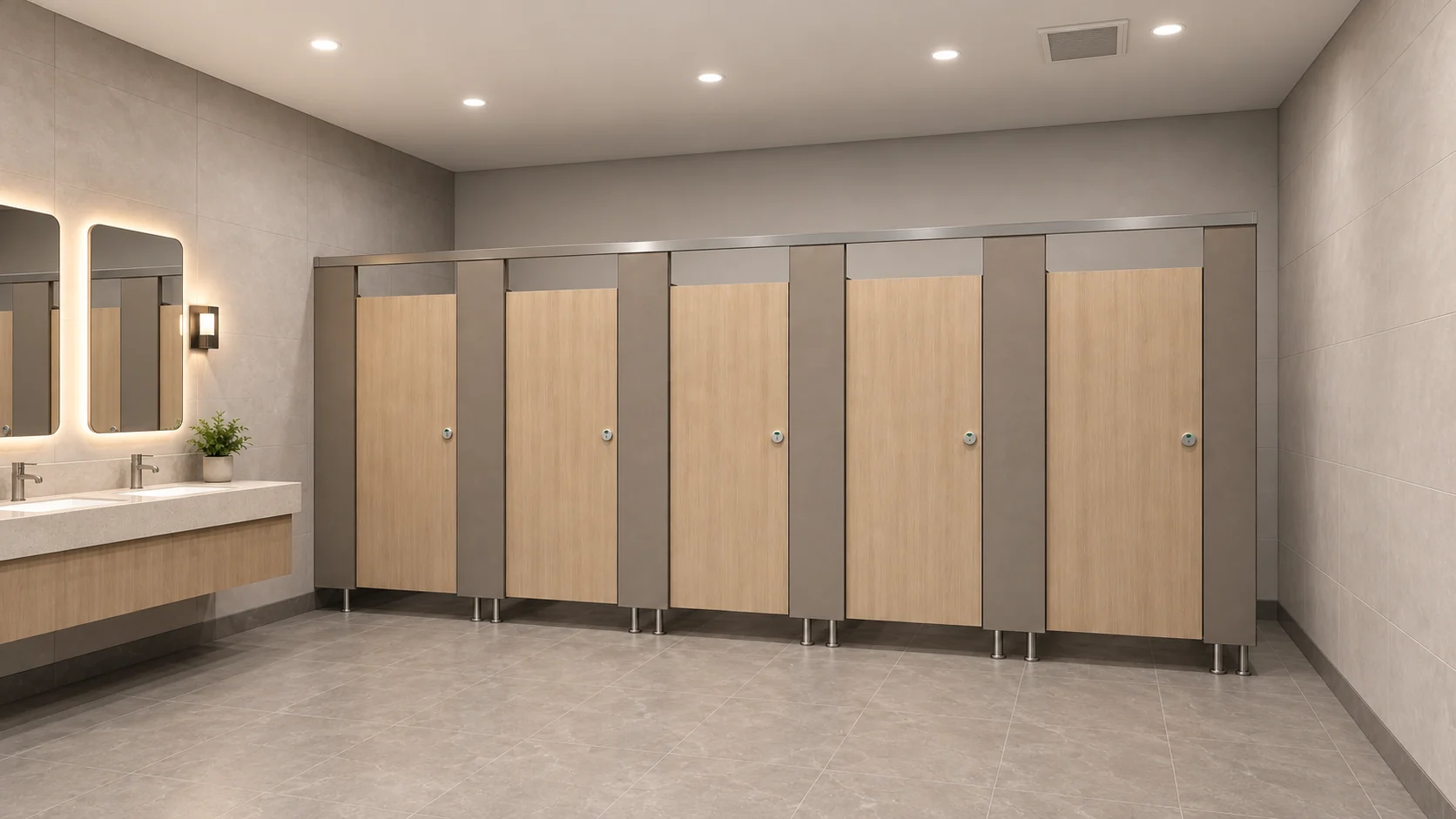
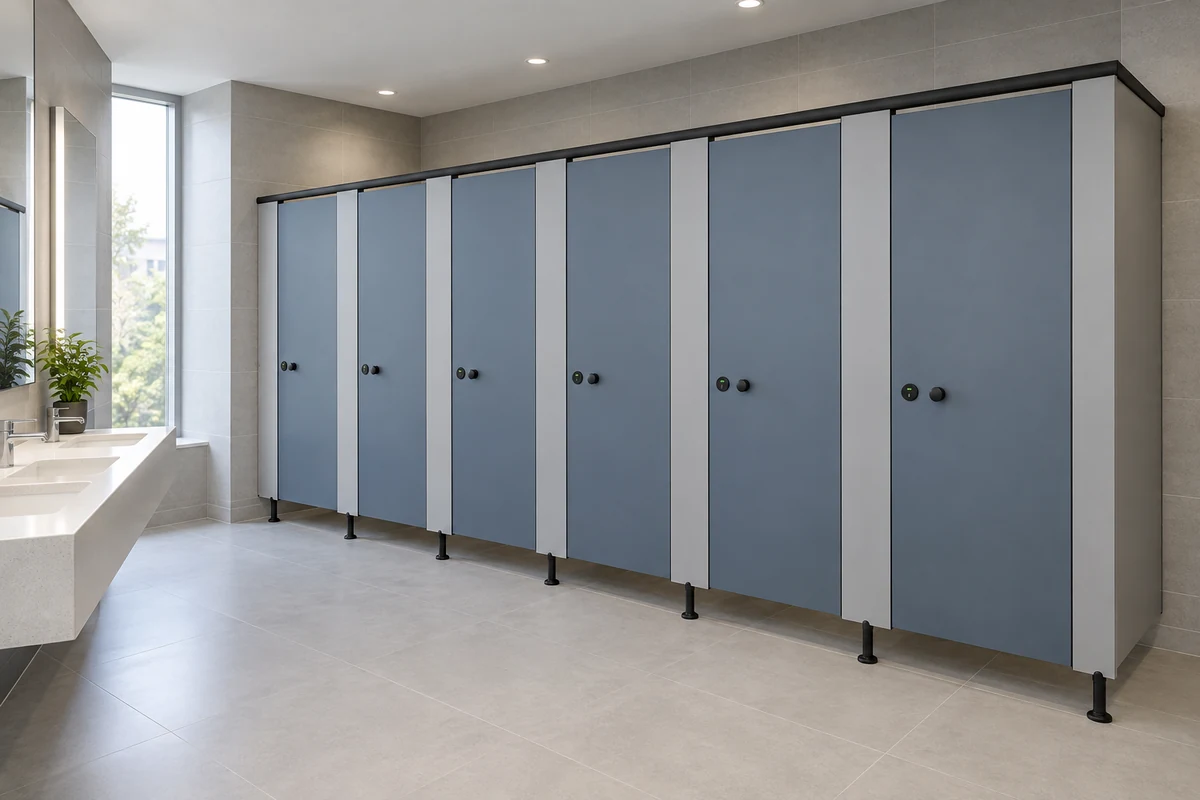
Evidence note: illustrations and generic references show design intent, not completed EBUNGE customer projects. They cannot be used to infer hidden construction, material equivalence or performance.
Start With Layout and Privacy Review
Layout review should begin with the room geometry and the intended user experience. Project teams can check whether the cubicle arrangement fits the available footprint, whether door swings conflict with adjacent fixtures, and whether privacy expectations are described in the schedule. These are review topics, not automatic compliance statements.
Questions for the layout review
- Does the schedule identify each cubicle location and its relationship to walls, columns and services?
- Are door swing directions and clearance zones shown consistently?
- Is privacy addressed as a project requirement rather than assumed from a generic image?
- Are accessible cubicle requirements listed with the applicable local reference?
Where the schedule is silent, the project team should record the gap. The project team should confirm project-specific requirements against the relevant approved technical evidence.
Door Operation and Hardware Coordination
Door operation is a frequent source of tender ambiguity. The schedule may describe a door type, but the hardware interface, hinge position, latch arrangement and closing behaviour still need project-specific confirmation. Do not treat HPL, compact laminate, phenolic or stainless steel as interchangeable. Each material family has its own coordination implications, and the schedule should not imply equivalence without approved evidence.
Hardware items to verify against drawings
- Confirm the door operation described in the schedule matches the architectural drawing.
- Check that hinge, latch and support interfaces are shown or referenced.
- Verify that any hardware item named in the schedule has an approved technical reference.
- Record any item that remains generic so it can be resolved before tender award.
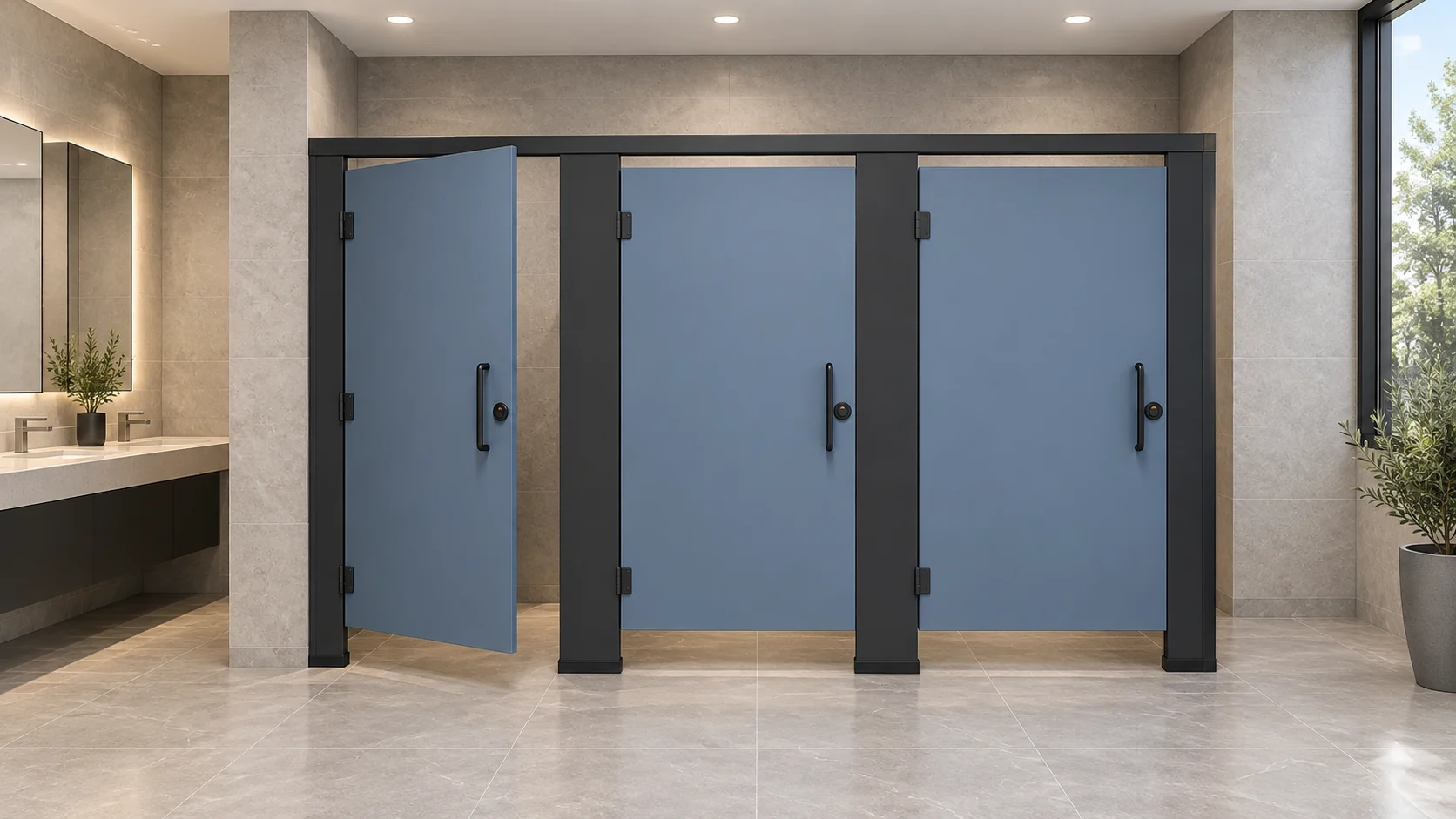
This is also where the product overview can help the team understand the commercial Toilet Partition / Toilet Cubicle category without turning a category page into a project specification.
Support Interfaces and Mounting Review
Support interfaces connect the cubicle system to the building structure. The tender schedule should identify what the partition relies on: floor, wall, ceiling or a combination. It should also state who is responsible for setting out and verifying those interfaces. Without that clarity, installation risk moves downstream.
Project-specific mounting details require approved technical evidence. A generic illustration cannot confirm a fixing method, substrate condition or structural capacity. The review team should mark any support interface that depends on site verification and keep it open until the relevant drawing or method statement is available.
Cleaning Documentation and Maintenance Access
The schedule should indicate how the specified cubicle arrangement is expected to be cleaned and maintained. It should also identify access requirements for hardware adjustment or replacement.
Cleaning and access checklist
- Is the cleaning method described without assuming a performance rating?
- Are maintenance access points identified for door hardware and support interfaces?
- Does the schedule separate routine cleaning from planned maintenance?
- Are any cleaning restrictions linked to a project-specific material confirmation?
These points help owners and facility teams plan operation. They do not replace local requirements or manufacturer instructions.
Applicable Local Requirements and Compliance Language
The project team should verify those references against the applicable jurisdiction. This article cannot assert compliance with any local requirement. Instead, the schedule should identify the relevant local reference and the evidence needed to demonstrate it.
Where a schedule uses words such as compliant, certified or rated, the project team should ask for the matching approved technical evidence. If that evidence is not available, the term should be treated as unverified and resolved before tender comparison.
Comparison Table for Tender Review
| Review area | What to check | Evidence needed |
|---|---|---|
| Layout and privacy | Cubicle positions, door swings, clearance zones | Project drawings and privacy requirements |
| Door operation | Hinge, latch, closing behaviour, hardware interface | Approved hardware reference and drawing coordination |
| Support interfaces | Floor, wall or ceiling fixing responsibility | Project-specific mounting evidence |
| Cleaning and access | Cleaning method, maintenance access points | Project cleaning and maintenance documentation |
| Local requirements | Applicable code or accessibility reference | Jurisdiction-specific approved evidence |
Use this table as a working checklist, not as a substitute for project-specific technical review. The resources section can support general orientation, while final decisions remain with the project team.
Common Tender Schedule Gaps
Several gaps appear repeatedly in early tender reviews. The schedule may list a cubicle type without a corresponding support interface. It may describe a finish without an approved sample reference. It may include a performance term without a test report. It may also leave cleaning and maintenance responsibilities unassigned.
Each gap should be logged with an owner and a required evidence item.
FAQ: Toilet Partition Hardware Tender Schedule
What is a toilet partition hardware tender schedule?
It is a project document that lists the toilet partition hardware items, interfaces and requirements to be priced and coordinated. It should be read alongside architectural drawings and approved technical evidence.
Can a tender schedule confirm material performance?
No. A schedule can state a requirement, but material performance needs matching approved technical evidence. Do not infer performance from a generic illustration or category description.
How should the team handle missing dimensions?
Record the missing dimension as an open item. Project-specific dimensions require approved technical evidence and should not be assumed from a standard image or catalogue page.
Are HPL, compact laminate, phenolic and stainless steel interchangeable?
They should not be treated as interchangeable. Each material family has different coordination implications, and equivalence requires project-specific approved evidence.
What should be checked for door operation?
Check the door swing, hinge position, latch arrangement, closing behaviour and hardware interface against the architectural drawing and approved hardware reference.
When should the project team contact EBUNGE?
Contact EBUNGE when the project team needs to discuss the commercial Toilet Partition / Toilet Cubicle category or request project-specific documentation. Use the contact page to start that conversation.
Conclusion: Keep the Schedule Evidence-Bounded
A toilet partition hardware tender schedule is most useful when it separates confirmed product-category facts from project-specific requirements. EBUNGE product category includes commercial Toilet Partition / Toilet Cubicle. Beyond that, materials, hardware, dimensions, finishes, mounting methods and ratings require matching approved technical evidence. Project teams should review layouts, privacy, door operation, support interfaces, cleaning documentation and applicable local requirements without asserting unverified compliance. Illustrations remain generic design references, not completed EBUNGE customer projects.
For project-specific coordination, contact EBUNGE to discuss the commercial Toilet Partition / Toilet Cubicle category and the documentation your tender review requires.