
How to Verify Toilet Partition Hardware Data in Handover Files
Quick answer: toilet partition
Toilet partition hardware handover data is the set of documents, schedules and drawing notes that a project team receives when a washroom package is transferred from design or procurement into installation and closeout. The purpose of reviewing that data is not to accept it at face value, but to confirm that every hardware statement is either a maintained product fact or a project-specific item supported by approved technical evidence.
This article sets out a verification framework for overseas contractors, architects, interior designers, owners and renovation teams.
Why Handover Data Needs a Verification Step
Handover files are assembled under time pressure. They may combine catalogue extracts, shop drawings, schedules and correspondence. A hardware reference that is correct in one context can become misleading when copied into another. The review step separates three categories: confirmed product facts, project-specific decisions, and open items that still need evidence.
EBUNGE product category includes commercial Toilet Partition / Toilet Cubicle. That is a category statement, not a performance claim. It does not confirm a material, a hinge type, a fixing method, a dimension or a rating for any particular project. Those details require matching approved technical evidence before they are treated as settled.
What Counts as Confirmed Product Information
Confirmed information is limited to what the manufacturer maintains as a public or contractual fact. For this topic, the confirmed fact is the product category. Everything else in a handover file should be traceable to a project-specific approval, a signed schedule or a drawing revision.
Statements that need project evidence
Material composition, hardware type, dimensions, finish, mounting method and any rating are project-specific. They must not be inferred from an illustration, a generic brochure or a previous job. HPL, compact laminate, phenolic and stainless steel are not interchangeable descriptions, and a drawing should not be read as implying hidden construction.
Statements that should never appear
The project team should confirm project-specific requirements against the relevant approved technical evidence. Toilet cubicles are also not movable operable walls, so references to suspended travel, stacking or parking mechanisms do not belong in this context.
A Six-Step Review Process for Project Teams
- Register the document set. List every file, revision date and author so the team knows which version is under review.
- Tag each hardware statement. Mark it as confirmed category fact, project-specific decision, or open item.
- Check the drawing reference. Confirm that the hardware note points to the correct layout, elevation and door swing.
- Review support interfaces. Identify where partitions meet walls, floors, ceilings or adjacent finishes, and note who owns each interface.
- Confirm door operation. Check that the described operation matches the approved layout and does not rely on an assumed mechanism.
- Log open evidence requests. Send unresolved items to the responsible party with a clear question and a required response date.
Layout, Privacy and Door Operation Checks
Layout review should confirm that the cubicle arrangement, entry approach and door swing are consistent across plan, elevation and schedule. Privacy expectations should be described in terms of the approved design intent, not as a measured performance result. Where a project has specific privacy requirements, the team should record them as project criteria and request matching evidence.
Door operation review covers the direction of opening, the clearance shown on the drawing, and the interface between the door and any adjacent panel or pilaster. If the handover file describes a mechanism that is not shown on the approved drawing, that is an open item, not a confirmed feature.
Support Interfaces and Cleaning Documentation
Support interfaces are a common source of handover ambiguity. Cleaning documentation should describe the recommended routine for the approved finish, but it should not be converted into a durability or hygiene claim without evidence.
Applicable local requirements vary by jurisdiction. The project team should list the relevant requirements, record how the design responds to them, and avoid asserting compliance until the responsible professional has confirmed it. This is a documentation discipline, not a substitute for local code review.
Evidence Note: What the Illustrations Show
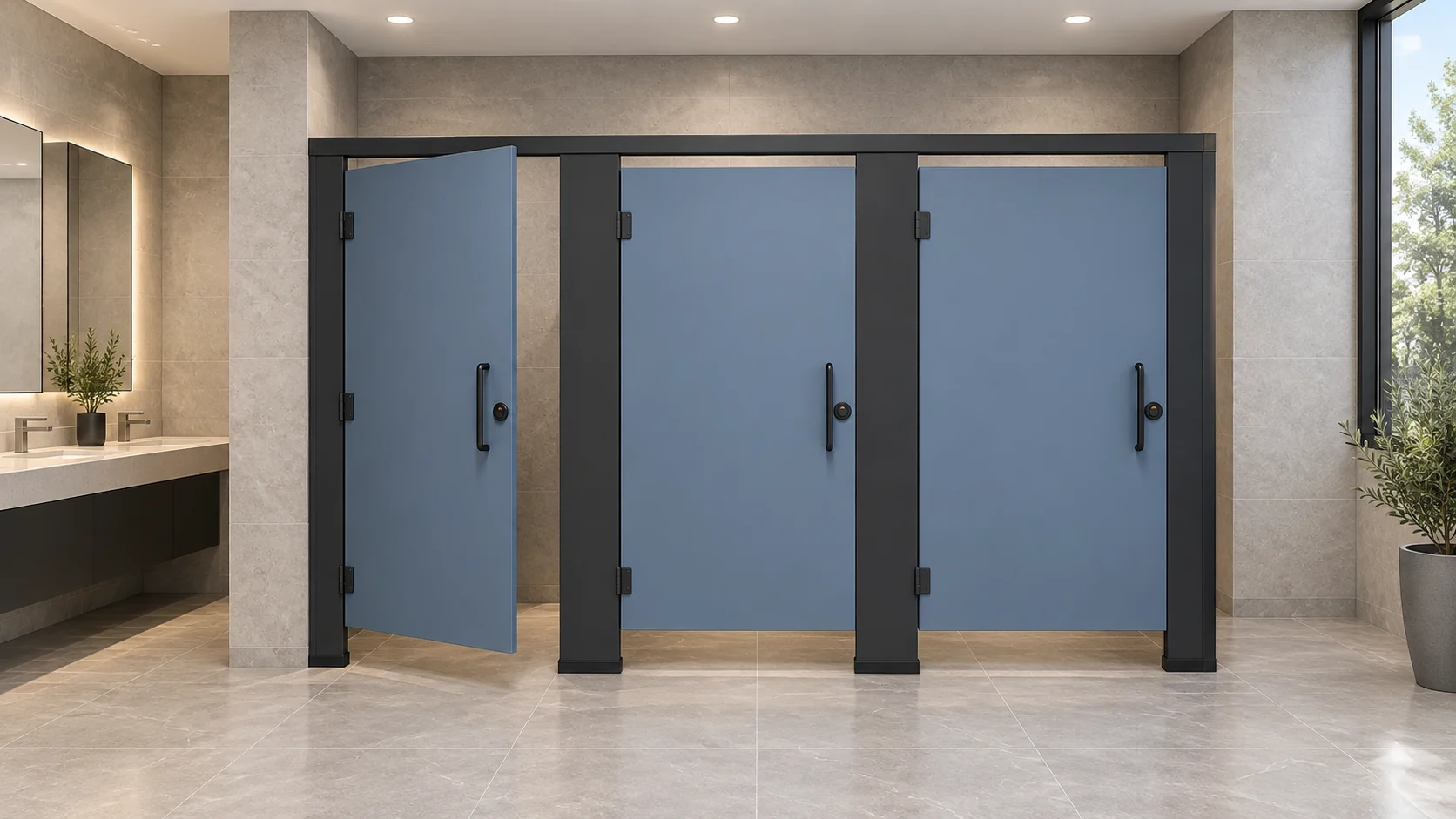
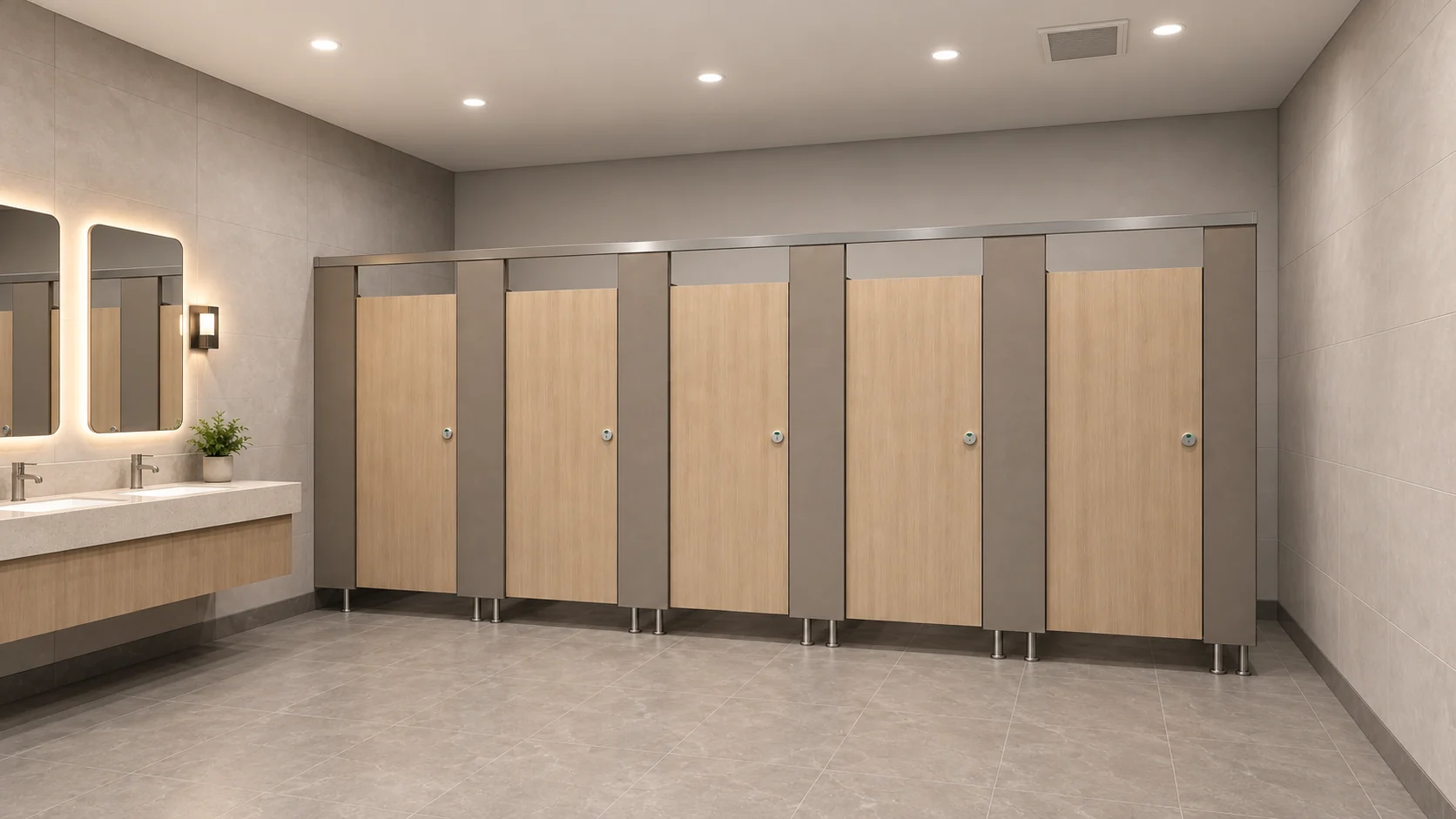
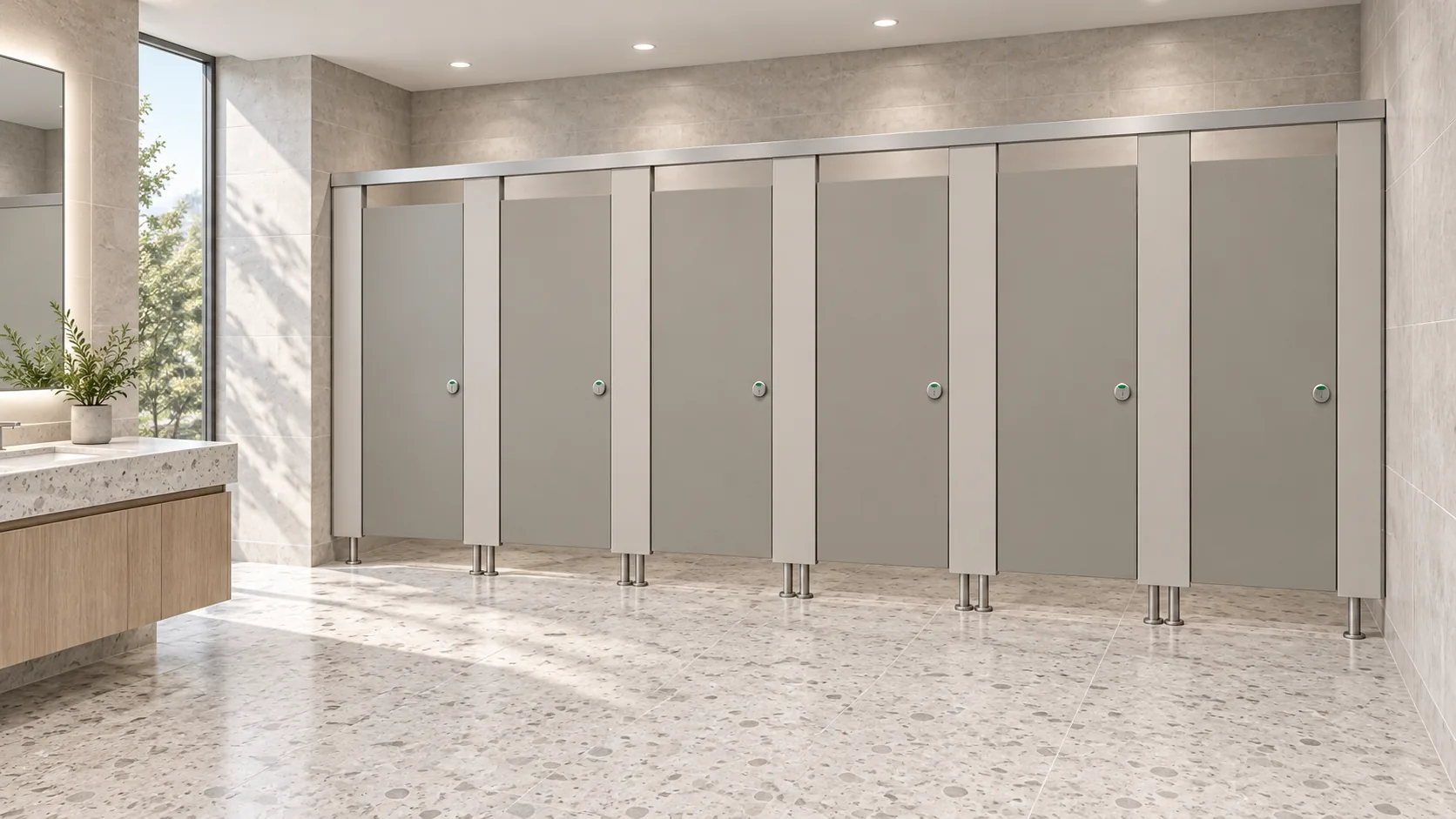
Illustrations in this article and on the product pages show generic design references, not completed EBUNGE customer projects. They are intended to support layout discussion only. They do not confirm a material, hardware item, dimension, finish, mounting method or rating for any specific project.
When a handover file includes an image, treat it as a visual reference. The written schedule and approved drawing remain the controlling documents. If the image and the schedule disagree, raise a query rather than choosing one silently.
Compact Comparison: Confirmed vs Project-Specific
| Item in handover file | Status | Action |
|---|---|---|
| Product category: commercial toilet partition / cubicle | Confirmed category fact | Use as context only |
| Material, finish, hardware type | Project-specific | Request approved technical evidence |
| Dimensions and mounting method | Project-specific | Verify against approved drawing |
| Ratings or performance statements | Project-specific | Do not accept without matching evidence |
| Cleaning routine | Project-specific | Confirm against approved finish documentation |
Coordination Between Trades and Suppliers
The contractor should maintain a single open-items log. The architect or designer should confirm design intent. The owner or operator should confirm operational expectations such as cleaning access and door use. The supplier should respond to evidence requests with project-specific documents rather than general statements.
For product category context, the toilet partition product range provides a starting point. For broader guidance, the resources section supports document review. When a project needs a specific hardware schedule or drawing response, the team should use the contact route to raise a defined question.
Frequently Asked Questions
What is toilet partition hardware handover data?
It is the set of documents, schedules and drawing notes that describe the hardware items associated with a toilet partition package at handover. It should distinguish confirmed product facts from project-specific decisions and open items.
Can a brochure image confirm a hardware item?
No. Illustrations show generic design references, not completed EBUNGE customer projects. A hardware item is confirmed only when it appears in approved project documentation with matching technical evidence.
Are HPL, compact laminate, phenolic and stainless steel interchangeable?
No. They should not be treated as interchangeable descriptions, and a handover file should not infer hidden construction from an illustration or a generic reference.
How should the team handle a missing rating?
Record it as an open item and request project-specific evidence. Do not fill the gap with an assumed value or a statement copied from another project.
Who should confirm local compliance?
The responsible local professional or authority should confirm applicable requirements. The project team can document the review, but it should not assert unverified compliance.
What is the first step in a handover review?
Register the document set with revision dates and authors, then tag each hardware statement as confirmed, project-specific or open. This prevents later confusion about which version was approved.
Conclusion and Next Step
Verifying toilet partition hardware handover data is a discipline of evidence boundaries. Confirm the category context, separate project-specific items, review layouts, privacy, door operation, support interfaces and cleaning documentation, and log every open question. Do not let an illustration or a generic statement become a project fact.
If your team is preparing a handover file and needs a defined response on a project-specific hardware question, contact EBUNGE with the relevant drawing reference and the evidence you already hold. The local publisher will place the approved images and CTA cards around this article; the written guidance above remains the controlling framework.