
How Facility Teams Budget Toilet Partition Hardware Renewal Cycles
Quick answer: toilet partition
Review focus: toilet partition.
Toilet partition hardware renewal planning is a budgeting and coordination exercise, not a product catalogue decision. Facility teams need a repeatable way to describe what is being reviewed, what evidence exists and what still requires project-specific confirmation. EBUNGE product category includes commercial Toilet Partition / Toilet Cubicle. That single confirmed fact is the starting point; every material, hardware, dimension, finish, mounting detail or rating must be matched to approved technical evidence before it enters a budget line.
Why Renewal Cycles Need an Evidence-Bounded Budget
A renewal cycle is often triggered by visible wear, door operation complaints, cleaning difficulty or a planned refurbishment. The project team should confirm project-specific requirements against the relevant approved technical evidence. They are observations that should be logged and reviewed by the project team.
The budget should separate three categories: inspection and documentation, project-team review, and any replacement scope confirmed by approved evidence. Mixing these categories creates false precision. A facility team can estimate internal labour and review time without inventing product prices, service life or warranty terms.
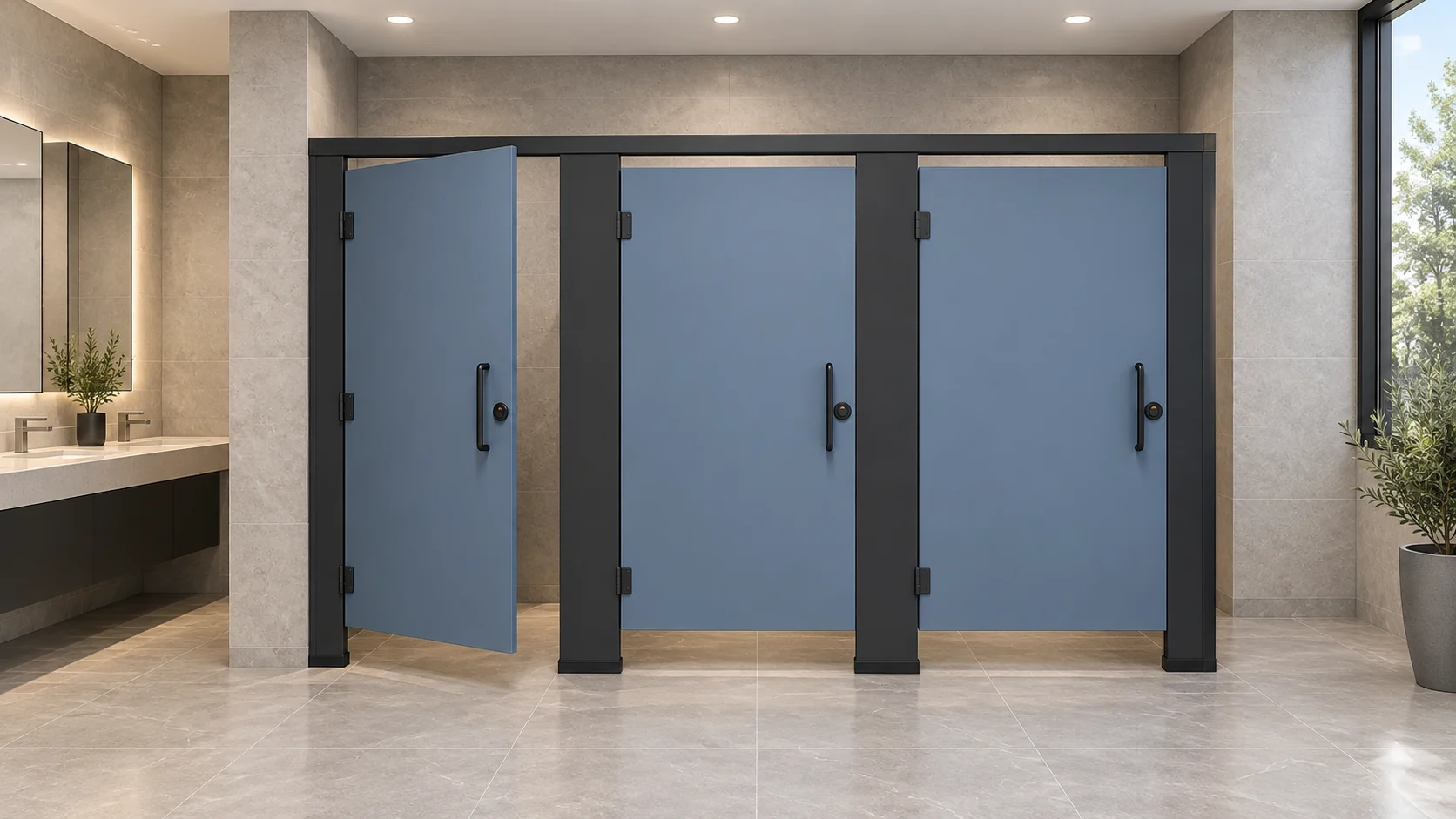
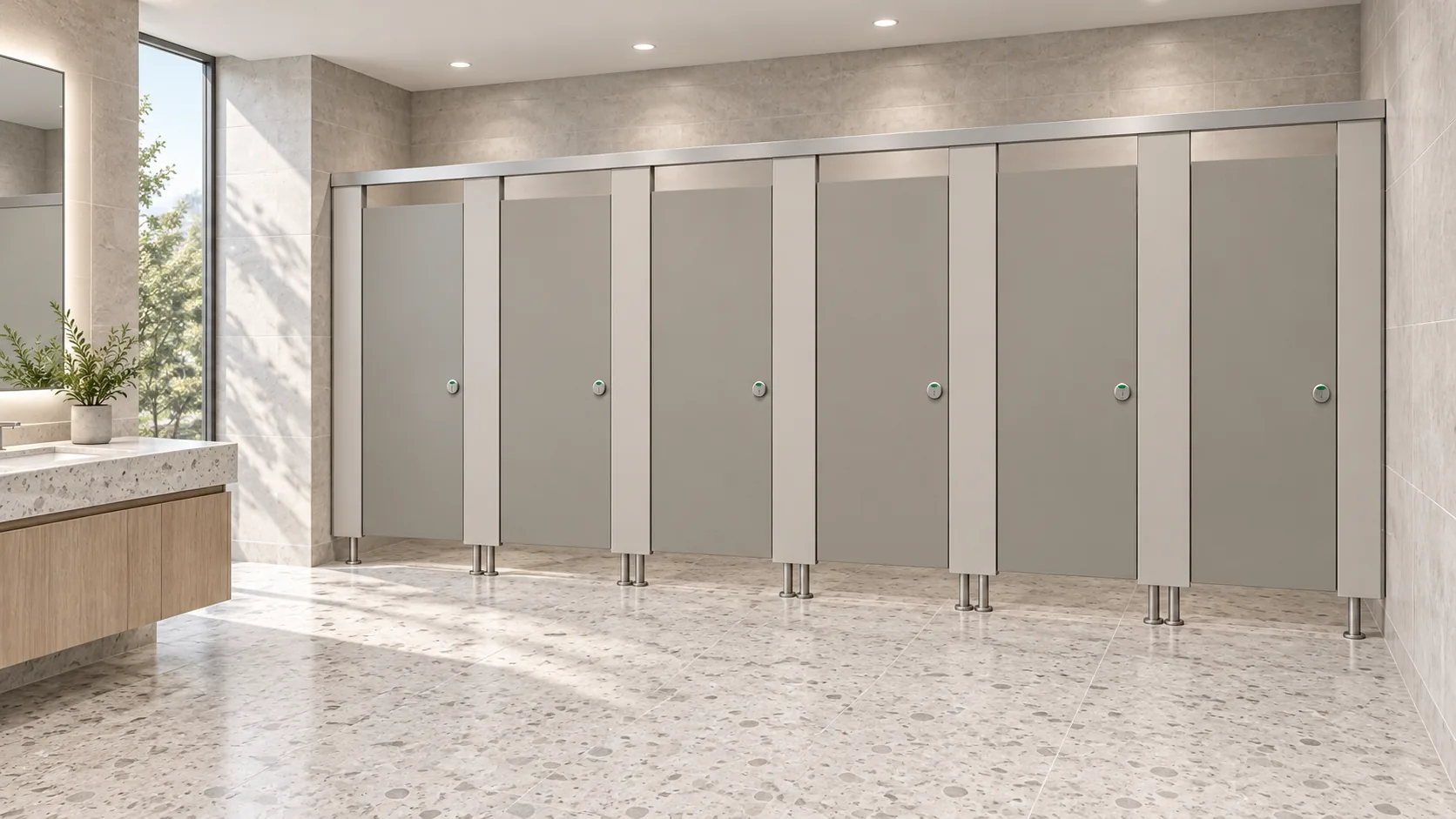
Planning boundary: any project-specific material, hardware, dimension, finish, mounting or rating requires matching approved technical evidence. Illustrations show generic design references, not completed EBUNGE customer projects.
Start With a Condition and Documentation Review
Before any renewal scope is drafted, the team should assemble what is already known. This is a documentation exercise, not a diagnosis. The goal is to identify gaps that must be closed before budgeting proceeds.
Information to collect
- Existing layout drawings and cubicle count, if available.
- Door operation notes from daily cleaning and maintenance staff.
- Support interface observations where cubicles meet walls, floors or adjacent elements.
- Cleaning documentation and any recurring difficulty reported by cleaning teams.
- Applicable local requirements identified by the project team, without asserting compliance.
Where drawings are missing or incomplete, the team should mark the gap rather than infer hidden construction from photographs or illustrations. A gap is a valid budget item because it represents review time.
Coordinate Layout, Privacy and Door Operation Reviews
Layout, privacy and door operation are related but separate review topics. A change in one can affect the others, so the project team should review them together rather than in isolation.
Layout review
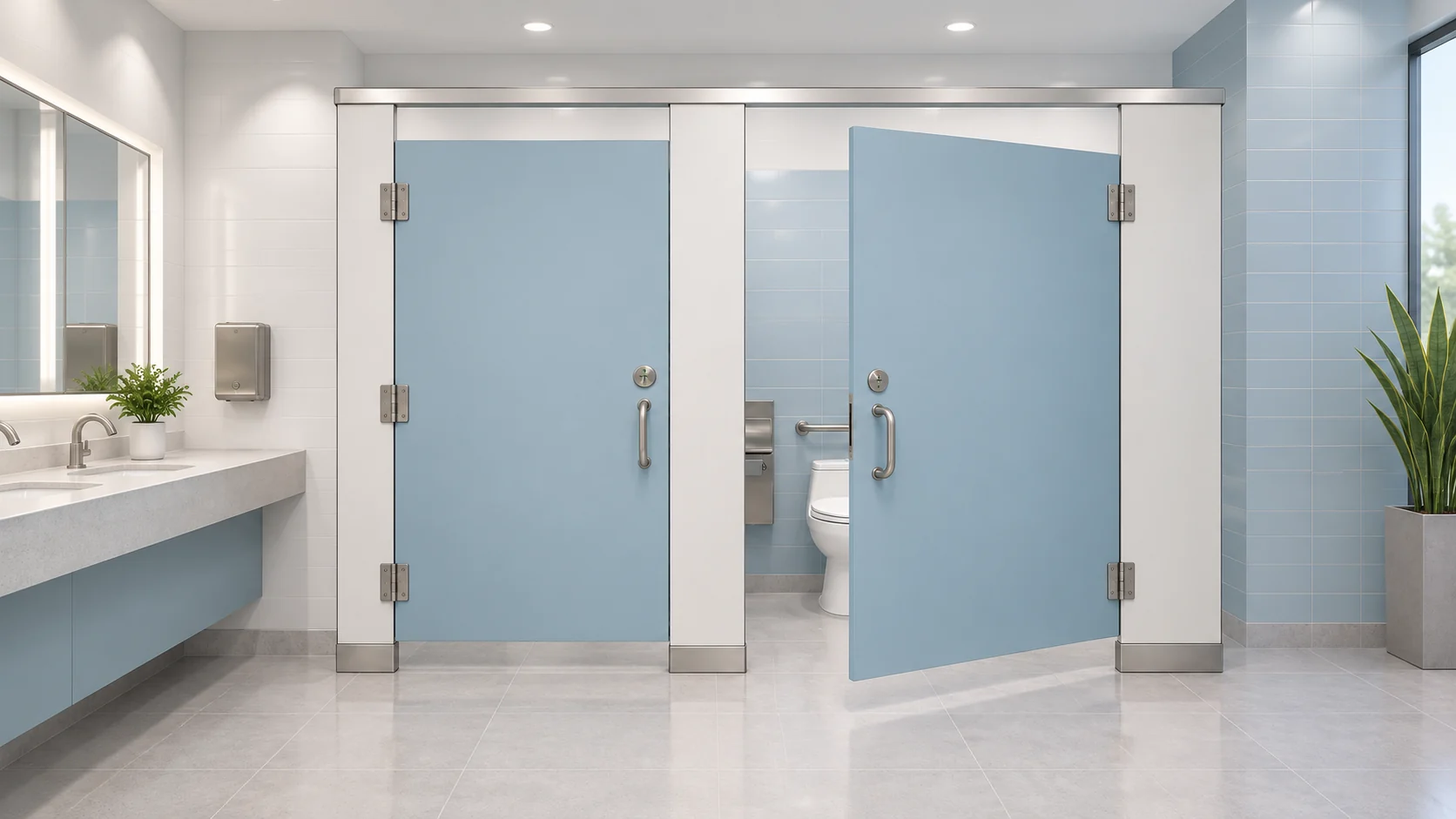
Confirm cubicle positions, circulation space and how the partition interfaces with surrounding construction. Do not assume that a generic illustration matches the actual site.
Privacy review
Privacy expectations should be described in project terms and checked against approved technical evidence. Do not claim acoustic or visual performance values unless they are supported by maintained documentation.
Door operation review
Record how doors currently operate, what users report and what the project team needs to verify. Door hardware details are project-specific and require matching approved evidence.
Define Support Interfaces and Cleaning Documentation
Support interfaces are the points where the partition system meets other building elements. The project team should describe these interfaces in drawings and confirm them on site. This is a coordination task, not a structural conclusion.
Cleaning documentation should be reviewed alongside the layout. If cleaning teams report difficulty, the project team should record the location and the task involved. The review can then determine whether the issue relates to access, layout or another documented factor.
| Review area | What to document | Evidence needed before budgeting |
|---|---|---|
| Layout | Cubicle positions, circulation, interfaces | Current drawings or measured survey |
| Privacy | Project expectations and review notes | Approved technical evidence for any claimed value |
| Door operation | User reports, maintenance notes | Project-specific hardware confirmation |
| Support interfaces | Wall, floor and adjacent element conditions | Site verification and approved mounting evidence |
| Cleaning | Recurring difficulty and location | Cleaning documentation and review notes |
A Step-by-Step Budgeting Process for Facility Teams
- Log the renewal trigger and date it. Keep observations factual.
- Collect existing drawings, cleaning notes and maintenance reports.
- Walk the site with the project team and record layout, privacy, door operation and support interface observations.
- Identify evidence gaps and assign review owners.
- Separate internal review costs from any replacement scope that has approved evidence.
- Draft a scope description that uses only confirmed product facts and project-specific evidence.
- Route the draft through the project team for review before any commercial discussion.
This process does not produce a price. It produces a defensible basis for requesting one. For maintained product context, see the EBUNGE product category.
What Requires Project-Specific Evidence
Several items commonly appear in renewal budgets but cannot be treated as general product facts. They require matching approved technical evidence for the specific project.
- Material composition and finish selection.
- Hardware type and mounting detail.
- Dimensions and load capacities.
- Warranty terms and service life.
- Prices and quotation terms.
Reviewing Local Requirements Without Asserting Compliance
The project team should identify applicable local requirements and document how they will be addressed. This is a review activity. It does not confirm compliance, and it should not be presented as a certification or approval.
That note becomes part of the budget rationale. Additional planning resources are available in the EBUNGE resources section.
Frequently Asked Questions
What is toilet partition hardware renewal planning?
It is a facility-team process for reviewing condition, layout, privacy, door operation, support interfaces, cleaning documentation and applicable local requirements before any replacement scope is budgeted. It relies on maintained product facts and project-specific evidence.
Can a facility team estimate renewal costs without product prices?
Yes, partially. Internal review time, site survey effort and documentation work can be estimated. Any product or installation cost requires approved commercial evidence for the specific project.
Which statements need project-specific evidence?
Material, hardware, dimension, finish, mounting and rating statements all need matching approved technical evidence.
How should the project team handle missing drawings?
Treat missing drawings as an evidence gap. Record the gap, assign a review owner and include the survey or documentation effort in the budget rather than inferring construction from illustrations.
Does renewal planning confirm compliance with local requirements?
No. The project team can identify applicable local requirements and document how they will be reviewed, but compliance is a separate determination that requires appropriate evidence and authority.
Are illustrations of toilet cubicles project references?
No. Illustrations show generic design references, not completed EBUNGE customer projects. They should not be used to infer dimensions, materials, hardware or performance.
Conclusion and Next Step
A disciplined renewal cycle budget is built on documented observations, clear evidence gaps and project-team review. Keep the confirmed product fact in view: EBUNGE product category includes commercial Toilet Partition / Toilet Cubicle. Everything beyond that requires project-specific confirmation.
To discuss a specific project review, contact the EBUNGE team with your layout notes, evidence gaps and applicable local requirements. The team can help route the inquiry without inventing project facts.