
How to Compare Toilet Partition Hardware Samples in Tender Reviews
Quick project answer
Review focus: hardware samples.
Toilet partition hardware samples arrive in tender reviews as physical objects, yet they carry a heavy informational load. Project teams want to compare finishes, door operation, support interfaces and cleaning routines before committing to a specification. The project team should confirm project-specific requirements against the relevant approved technical evidence. Those attributes require separate, project-specific evidence.
This guide offers a structured way to compare samples while staying inside confirmed product facts and planning boundaries.
Why Hardware Samples Matter in Tender Reviews
Project review term: hardware samples.
Hardware samples give tender reviewers something tangible to handle, photograph and discuss. They help teams align on visible qualities such as surface appearance, edge condition and the general feel of a hinge or latch. However, visible qualities are not the same as certified performance.
For overseas projects, this separation is especially important. Local requirements, building codes and client standards vary. A sample that looks suitable in one market may need additional documentation in another.
Building an Evidence-Bounded Comparison Framework
Coordination scope: hardware samples.
Before comparing samples side by side, agree on the evidence categories the team will use. This prevents the discussion from drifting into unverified claims.
- Visible sample attributes: surface appearance, edge profile, colour consistency and general workmanship as presented.
- Door operation observations: how the sample door moves, closes and aligns in the review setting, without inferring long-term performance.
- Support interface questions: how the sample might connect to walls, floors or adjacent panels, subject to project drawings.
- Cleaning documentation: what cleaning instructions or material care information accompany the sample.
- Applicable local requirements: which local standards or client specifications the project team must verify separately.
- Open evidence gaps: any performance, dimension, finish or rating that still needs approved technical evidence.
This framework does not rank materials or imply that one hardware type is interchangeable with another. HPL, compact laminate, phenolic and stainless steel each have distinct characteristics that require their own evidence. The framework simply organises the review conversation.
A Step-by-Step Sample Review Process
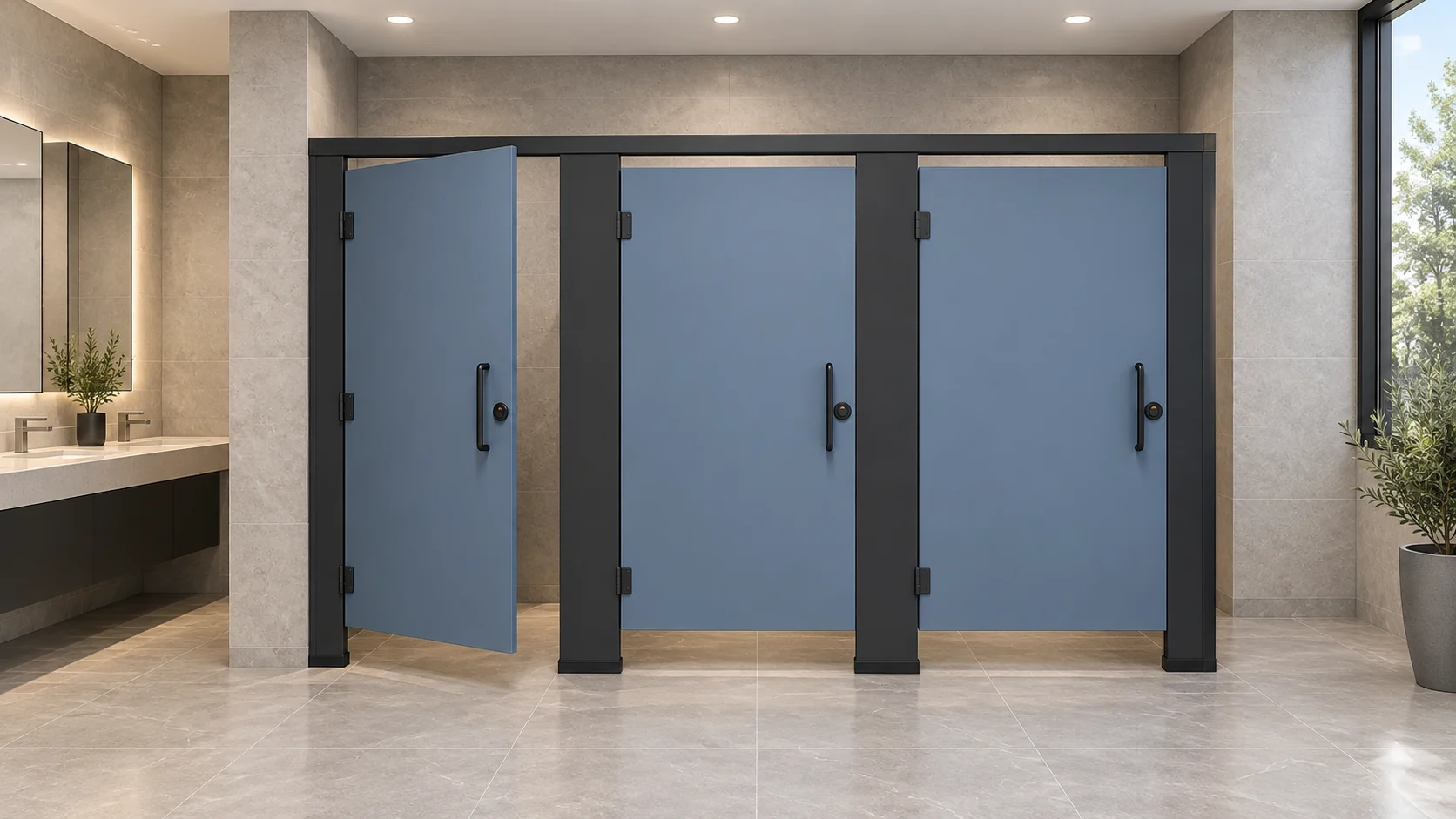
A repeatable process helps tender teams compare multiple samples without losing track of evidence limits. The steps below can be adapted to the size of the project and the number of samples under review.
- Log each sample: record the sample identifier, the date received and the supplier reference, without assuming the sample represents a full production configuration.
- Photograph visible features: capture consistent angles of hinges, latches, edges and surfaces for the tender record.
- Document door operation: note how the sample door opens, closes and rests, using neutral language that does not claim tested performance.
- Map support interfaces: sketch or annotate how the sample might meet walls, floors and panels, then cross-check against project drawings.
- Collect cleaning information: file any care or cleaning documentation provided with the sample.
- List open questions: identify every project-specific material, hardware, dimension, finish, mounting or rating that still requires matching approved technical evidence.
- Assign follow-up owners: give each open question to a named team member for resolution before the tender decision.
Include step seven in the project-team review. Without clear ownership, evidence gaps can persist into construction and cause late-stage changes. A simple action log keeps the review honest and traceable.
Comparing Samples Without Overstepping Facts
It is tempting to treat a well-made sample as proof of overall quality. In tender reviews, that temptation should be resisted. The confirmed product fact for this category is limited: EBUNGE product category includes commercial Toilet Partition / Toilet Cubicle.
When comparing samples, use language that distinguishes observation from verification. For example, write “the sample door closed smoothly during the review” rather than “the door is rated for high-frequency use.” Write “the surface appeared uniform under review lighting” rather than “the material is scratch-resistant.” This discipline protects the project team from making commitments the evidence does not support.
Evidence note: A physical sample is a design reference, not a certificate. Any project-specific material, hardware, dimension, finish, mounting or rating requires matching approved technical evidence before it can be treated as confirmed.
Coordinating with Drawings, Layouts and Privacy Goals
Hardware samples do not exist in isolation. They interact with cubicle layouts, door swings, privacy expectations and support interfaces. The project team should review the sample alongside the current drawings and note any mismatch between the sample and the drawn condition.
Layout and door operation
Check whether the sample door operation is compatible with the intended layout. Consider clearance, swing direction and the position of adjacent cubicles. These are project-specific considerations that require drawing review, not assumptions from the sample alone.
Privacy and support interfaces
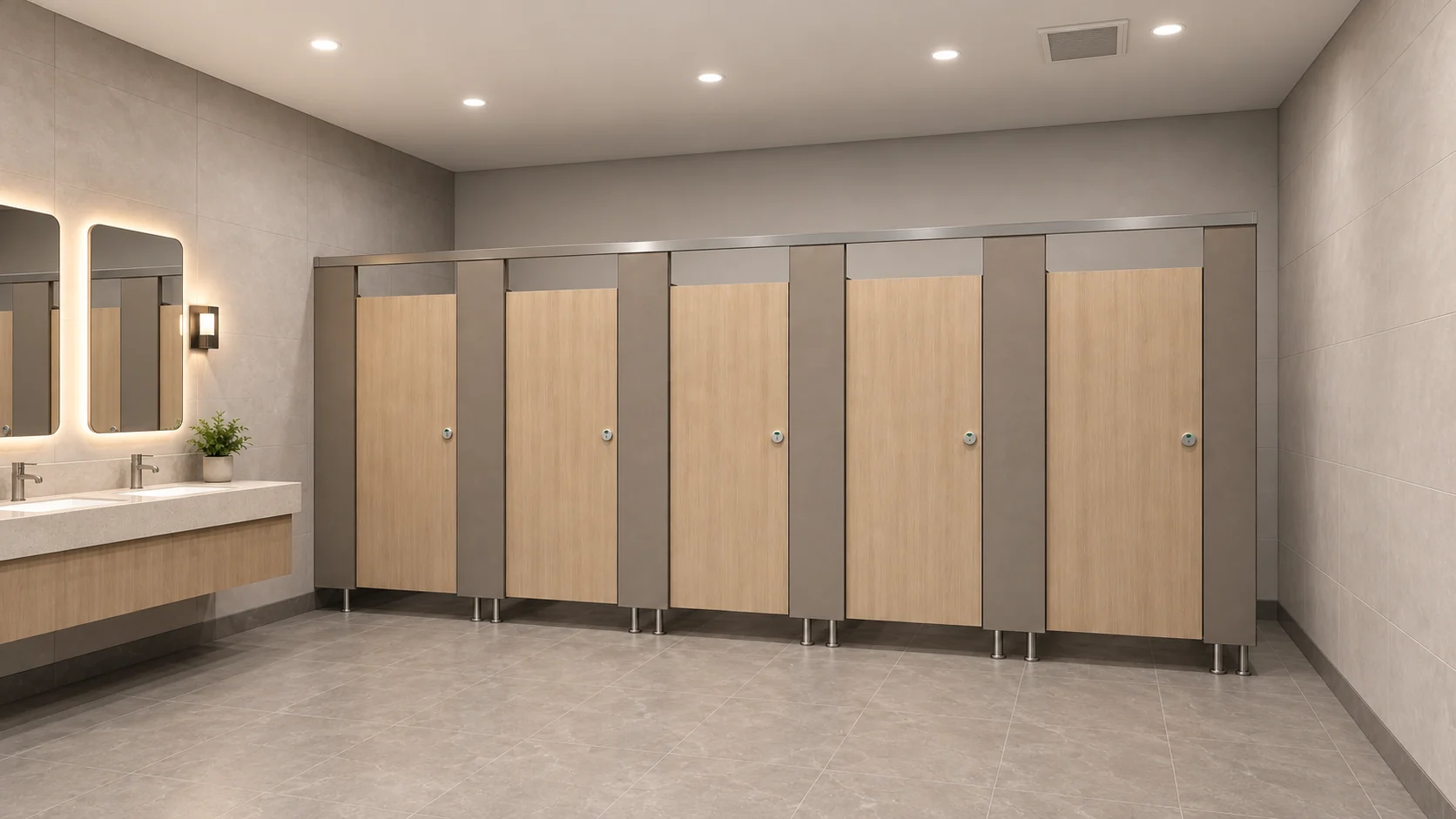
Privacy expectations vary by market and client. The sample may show a door edge or gap condition, but the project team must confirm whether that condition meets the applicable local requirements and the owner’s brief.
Cleaning Documentation and Maintenance Planning
Cleaning documentation is a practical part of the tender review. Ask what care information accompanies the sample and whether it aligns with the cleaning products and routines used by the facility. Do not assume that a sample surface is compatible with every cleaning agent.
Maintenance planning should also remain evidence-bounded. The sample may show a hinge or latch, but it does not confirm service life or warranty terms. Those items require separate commercial and technical confirmation.
Common Pitfalls in Sample Comparison
Several pitfalls appear repeatedly in tender reviews. Recognising them early helps the team stay disciplined.
- Treating materials as interchangeable: HPL, compact laminate, phenolic and stainless steel are not the same, and a sample of one does not confirm the behaviour of another.
- Inferring hidden construction: what is visible on the outside of a sample does not reveal internal build-up or reinforcement.
- Assuming compliance: a sample does not demonstrate compliance with local codes or client standards.
- Confusing a sample with a finished project: illustrations and samples are generic design references, not completed EBUNGE customer projects.
- Leaving evidence gaps unassigned: open questions without owners tend to resurface during construction.
Each pitfall can be managed with a simple rule: if the sample does not visibly show it, and the approved technical evidence does not state it, it remains an open question.
Frequently Asked Questions
What can a toilet partition hardware sample actually confirm?
A sample can confirm visible attributes such as surface appearance, edge condition and general workmanship as presented. It can also show how a door or latch operates in the review setting.
How should the project team document sample observations?
Use neutral, factual language. Record what was seen and handled, with photographs and dates. Avoid words that imply tested performance. Keep the sample log alongside the tender file so that later reviewers can see exactly what was observed and what remained open.
When does a sample comparison require approved technical evidence?
Any time the discussion moves to project-specific material, hardware, dimension, finish, mounting or rating. Those items require matching approved technical evidence. The sample alone cannot substitute for that evidence, even if it looks convincing.
Can samples from different materials be compared directly?
They can be reviewed side by side for visible attributes, but they should not be treated as interchangeable. HPL, compact laminate, phenolic and stainless steel have distinct characteristics. Each requires its own evidence path and its own project-specific confirmation.
What role do local requirements play in the review?
Local requirements shape what the project team must verify. The sample review should identify which local standards or client specifications apply, then confirm compliance through the appropriate evidence channels. The review itself should not assert unverified compliance.
How should cleaning documentation be handled during tender review?
Collect any care or cleaning information provided with the sample, review it with the facilities team and flag gaps. Do not assume that a sample surface is compatible with every cleaning product. Cleaning documentation is part of the evidence set, not an afterthought.
Conclusion: A Disciplined Path to Better Tender Decisions
Comparing toilet partition hardware samples in tender reviews is most useful when it stays within evidence boundaries. Samples help teams discuss visible qualities, door operation, support interfaces and cleaning documentation. They do not replace approved technical evidence for project-specific materials, dimensions, finishes, mountings or ratings.
For product category context, visit the EBUNGE products page. For additional planning guidance, see the resources section. When your team is ready to discuss a specific project, contact EBUNGE to coordinate the next steps.