
How to Structure a Toilet Partition Handover Documentation Set
Quick answer: toilet partition
A toilet partition handover documentation set is the controlled package that helps a project team verify what was reviewed, what was supplied and what still requires project-specific confirmation. It is not a substitute for approved drawings, local code review or signed submittals. EBUNGE product category includes commercial Toilet Partition / Toilet Cubicle.
This article explains how to structure the set so that contractors, architects, interior designers, owners and renovation teams can coordinate without inventing performance, material or compliance claims.
The guiding rule is simple: every statement in the handover set should be traceable to maintained product facts, an approved project document or a clearly labelled open item. Illustrations show generic design references, not completed EBUNGE customer projects.
Start With a Document Control Register
Before writing any narrative, create a register that lists each document, its revision, its owner and its approval status. The register prevents old drawings from being treated as current and makes it obvious when a project-specific material, hardware, dimension, finish, mounting or rating still needs matching approved technical evidence.
Minimum register columns
- Document title and unique reference
- Revision number and issue date
- Prepared by and checked by
- Approval status and approver role
- Related drawing or submittal reference
- Open comments and required action
Keep the register as a living index. When a layout, door swing or support interface changes, the register should show which documents are superseded and which remain valid for review.
Define the Scope and Evidence Boundary
A handover set should state what it covers and what it does not. For a commercial toilet partition package, the scope may include layout review, privacy considerations, door operation, support interfaces and cleaning documentation. It should not assert unverified compliance, hidden construction or performance results.
Evidence note
Any project-specific material, hardware, dimension, finish, mounting or rating requires matching approved technical evidence. If that evidence is not available, record the item as open rather than filling the gap with an assumption.
This boundary protects the project team during inspections and final acceptance. It also keeps the documentation useful for future maintenance and renovation planning.
Structure the Layout and Privacy Review
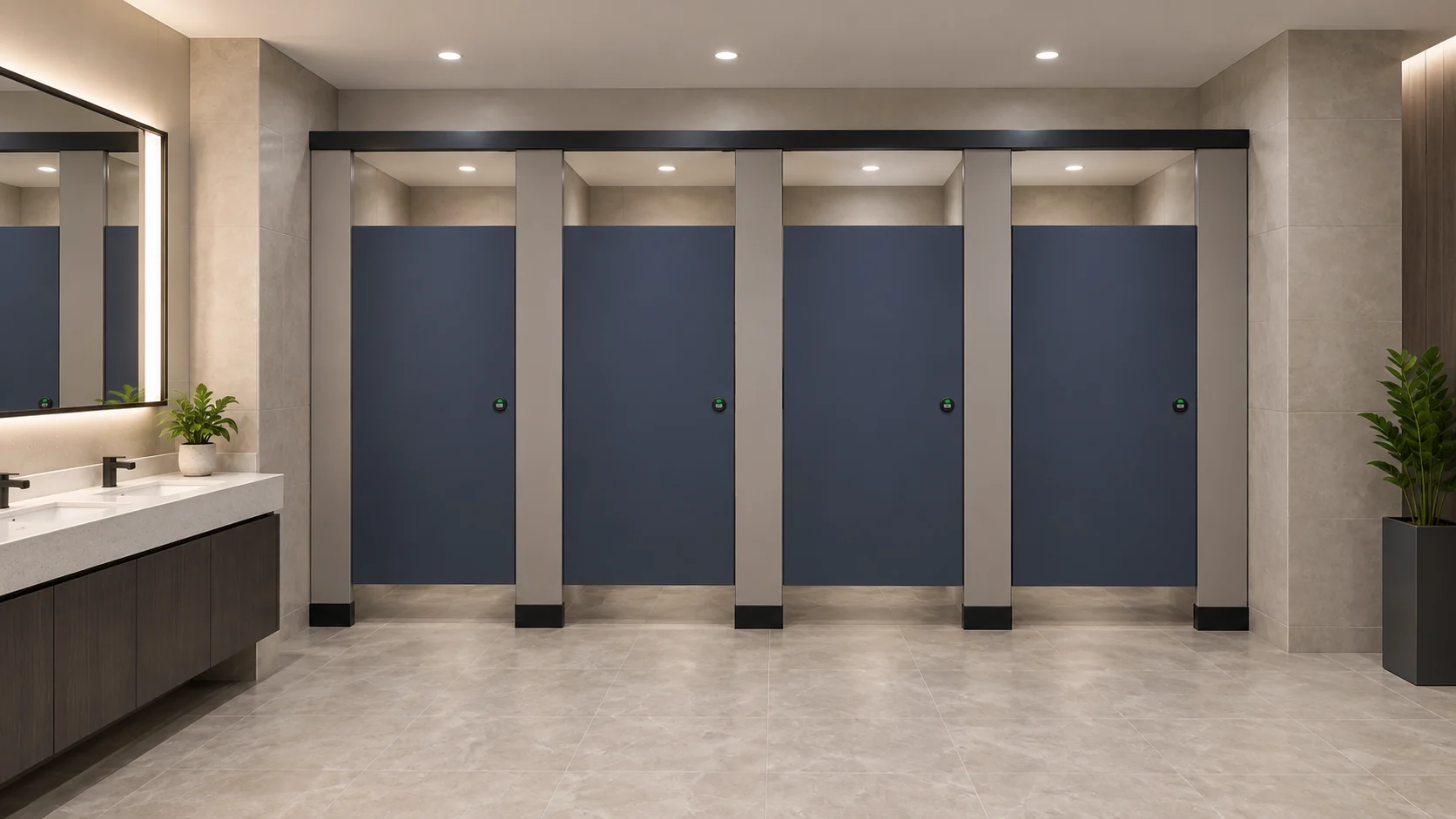
Layout review should describe how the cubicle arrangement relates to the surrounding room, circulation and service access. Privacy review should focus on sightlines, gaps and door operation as design considerations, not as certified performance claims.
Review points for the project team
- Confirm the approved layout drawing revision.
- Check that door operation is described consistently across documents.
- Record any privacy-related comments as design review items.
- Note where local requirements may apply and who will verify them.
- Link each comment to a drawing or submittal reference.
Do not treat HPL, compact laminate, phenolic or stainless steel as interchangeable. If a material is named in the project documents, the handover set should reference the approved specification rather than infer hidden construction from an illustration.
Document Door Operation and Support Interfaces
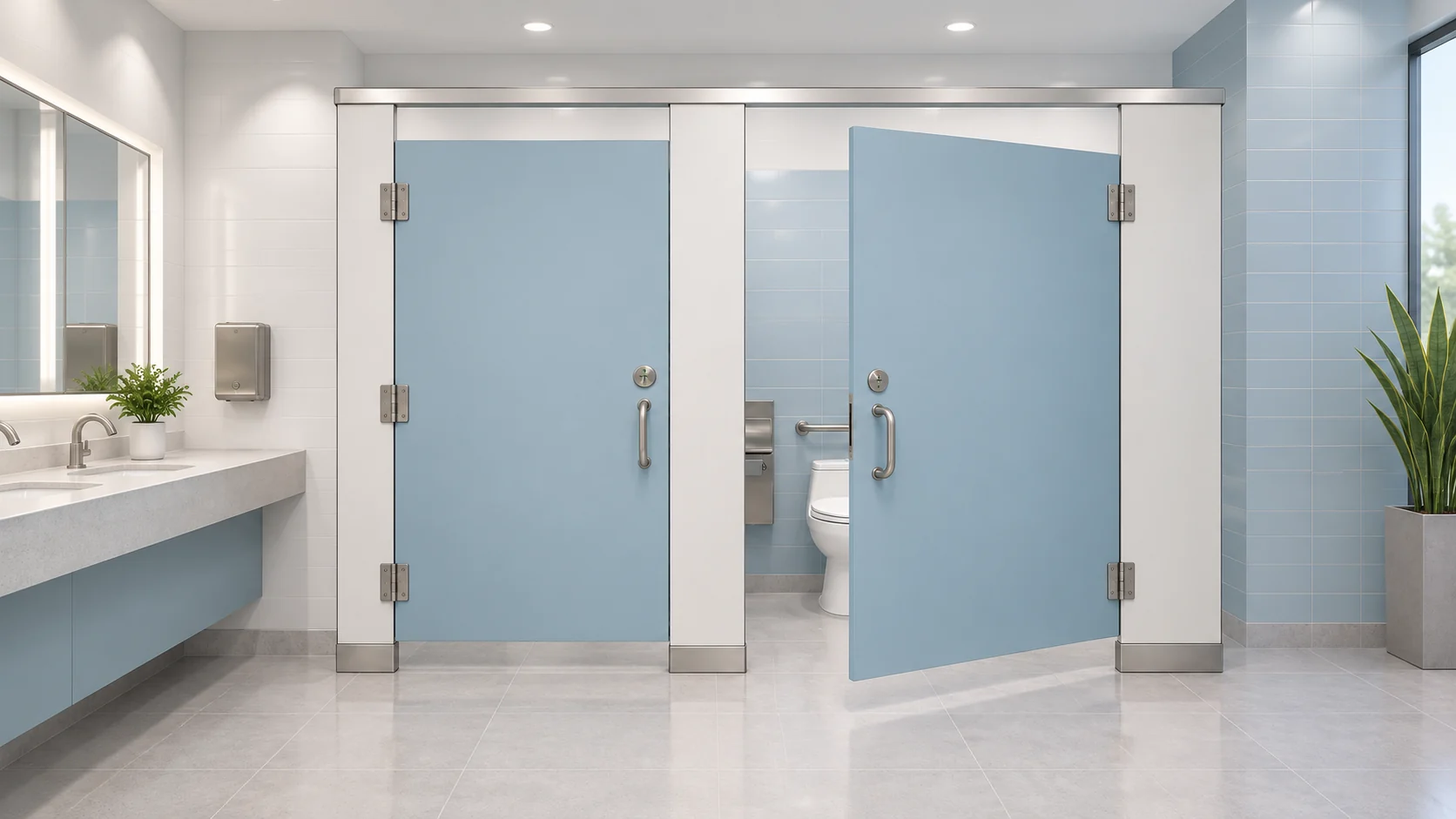
Door operation and support interfaces are common coordination points between the partition package and adjacent construction. The handover set should describe the interface responsibilities without inventing structural values or fixing methods that have not been approved.
Interface checklist
- Identify the supporting substrate or adjacent element by project reference.
- Record who is responsible for setting out and verifying the interface.
- List approved hardware references where they exist.
- Flag any unresolved coordination item for the project team.
- Keep a clear link between the interface note and the approved drawing.
Toilet cubicles are not movable operable walls. The documentation should not introduce suspended wall travel, stacking or parking mechanisms. Keep the language aligned with the fixed partition scope described in the approved project documents.
Include Cleaning and Maintenance Documentation
Cleaning documentation helps the owner and facilities team understand routine care expectations without making unsupported antimicrobial, waterproof or service-life claims. The handover set can list the cleaning instructions that were approved for the project and identify who supplied them.
Cleaning record structure
| Record type | Purpose | Owner |
|---|---|---|
| Approved cleaning instruction | Defines routine care steps | Project team |
| Material reference | Links care steps to the approved specification | Specifier |
| Open item log | Tracks unresolved care questions | Contractor |
Where a cleaning product or method has not been confirmed for the project, record it as an open item. The project team should confirm project-specific requirements against the relevant approved technical evidence.
Coordinate Local Requirements Without Claiming Compliance
Applicable local requirements vary by jurisdiction and project type. The handover set should identify which requirements the project team has reviewed and who is responsible for confirming them. It should not state that the package complies unless that conclusion is supported by the relevant approval.
Coordination steps
- List the local requirement categories relevant to the project.
- Assign a reviewer for each category.
- Record the review outcome and any required action.
- Attach the approval reference where available.
- Keep unresolved items visible in the register.
This approach supports Toilet Partition coordination across disciplines without turning a planning note into a compliance certificate.
Assemble the Final Handover Package
The final package should be ordered so a reviewer can move from scope to evidence to open items. A typical sequence is: register, scope statement, approved drawings, layout and privacy review notes, door operation and interface notes, cleaning documentation, local requirement review notes and the open item log.
For product context, refer to the maintained EBUNGE product category. For general guidance material, use the resources section. If your project team needs to confirm a specific configuration, use the contact route rather than assuming a detail from a generic illustration.
Frequently Asked Questions
What is a toilet partition handover documentation set?
It is a controlled package that records the reviewed scope, approved references, interface notes, cleaning documentation and open items for a commercial toilet partition package.
Can the handover set confirm compliance with local rules?
No. It can identify which requirements were reviewed and who is responsible, but compliance conclusions require the relevant approval and project-specific evidence.
Should the handover set name a specific material or finish?
Only where the project has matching approved technical evidence. Otherwise, record the item as open and avoid inferring hidden construction from an illustration.
How should door operation be documented?
Describe door operation consistently with the approved drawings and record any coordination comments as review items linked to those drawings.
Are toilet cubicles movable operable walls?
No. Toilet cubicles should not be described as movable operable walls, and the documentation should not introduce suspended wall travel, stacking or parking mechanisms.
What should happen when evidence is missing?
Record the missing evidence as an open item, assign an owner and keep it visible in the register until the project team resolves it.
Conclusion and Next Step
A well-structured toilet partition handover documentation set keeps project teams aligned on layouts, privacy, door operation, support interfaces, cleaning documentation and applicable local requirements. It does not replace approved drawings or project-specific evidence. Keep every claim traceable, label open items clearly and avoid treating generic illustrations as completed EBUNGE customer projects.
To discuss a project-specific configuration, contact the EBUNGE team and confirm the approved technical evidence before finalising the handover package.