
BIM Clash Detection for Toilet Partition Hardware Zones
Quick answer: toilet partition
Toilet partition hardware BIM clash detection is a coordination exercise, not a compliance certificate. It helps a project team see where door swings, support interfaces and cleaning access may compete with other building services before installation begins. EBUNGE product category includes commercial Toilet Partition / Toilet Cubicle. This article sets out an evidence-bounded framework for reviewing hardware zones in a federated model.
It does not confirm any project-specific material, dimension, mounting or rating. Those items require matching approved technical evidence and a project drawing review.
Why Hardware Zones Deserve Their Own Clash Review
Toilet partition hardware sits in a dense part of the building. Doors, hinges, latches, support interfaces and adjacent services all occupy the same small volume. A general model review may treat the cubicle as a single block and miss the hardware zone entirely.
A focused review asks a narrower question: does the space around each hardware item remain workable once the model is coordinated? That question belongs to the project team, not to a generic product description. The team should review layouts, privacy, door operation, support interfaces, cleaning documentation and applicable local requirements without asserting unverified compliance.
What the Model Can and Cannot Show
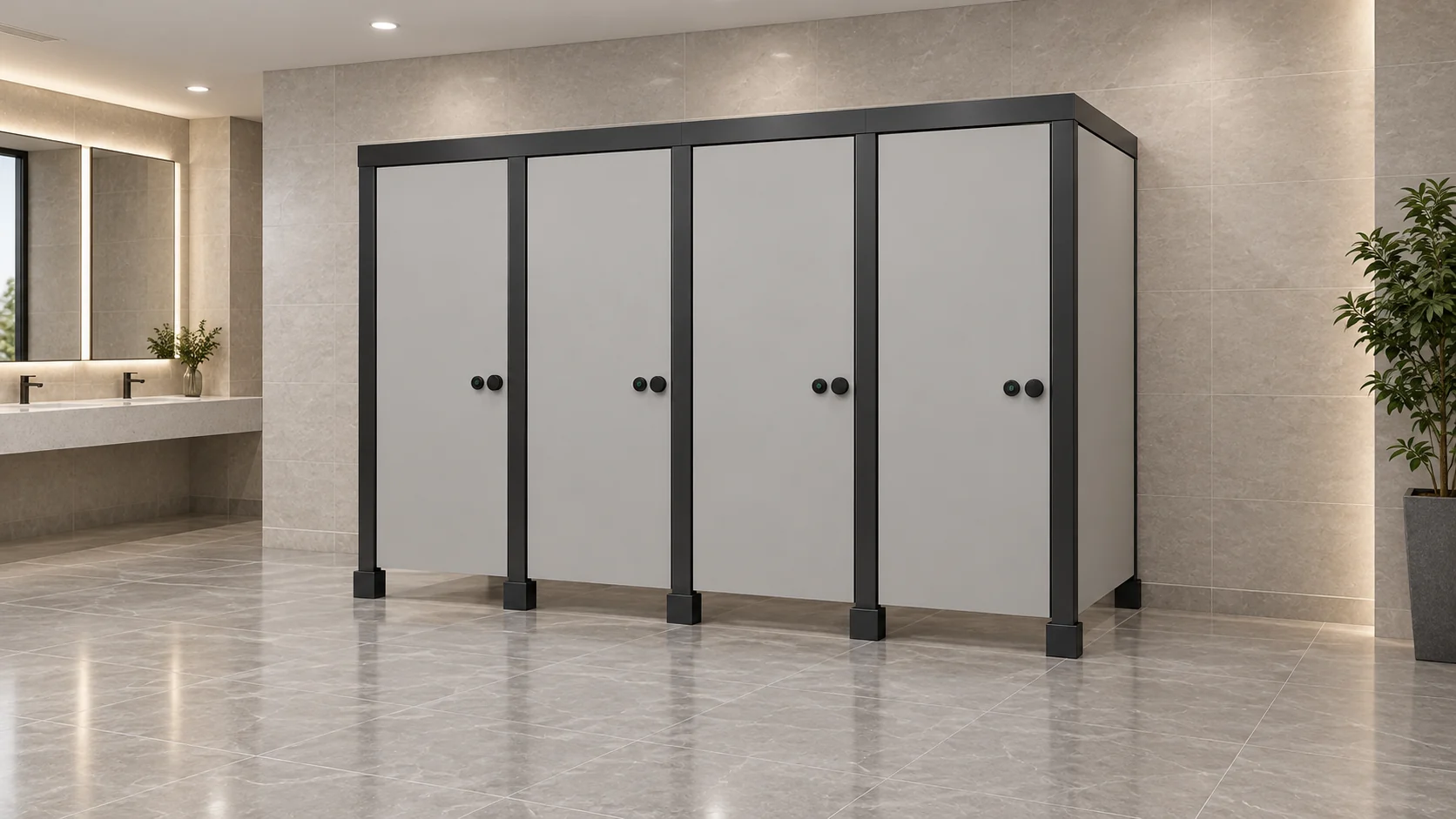
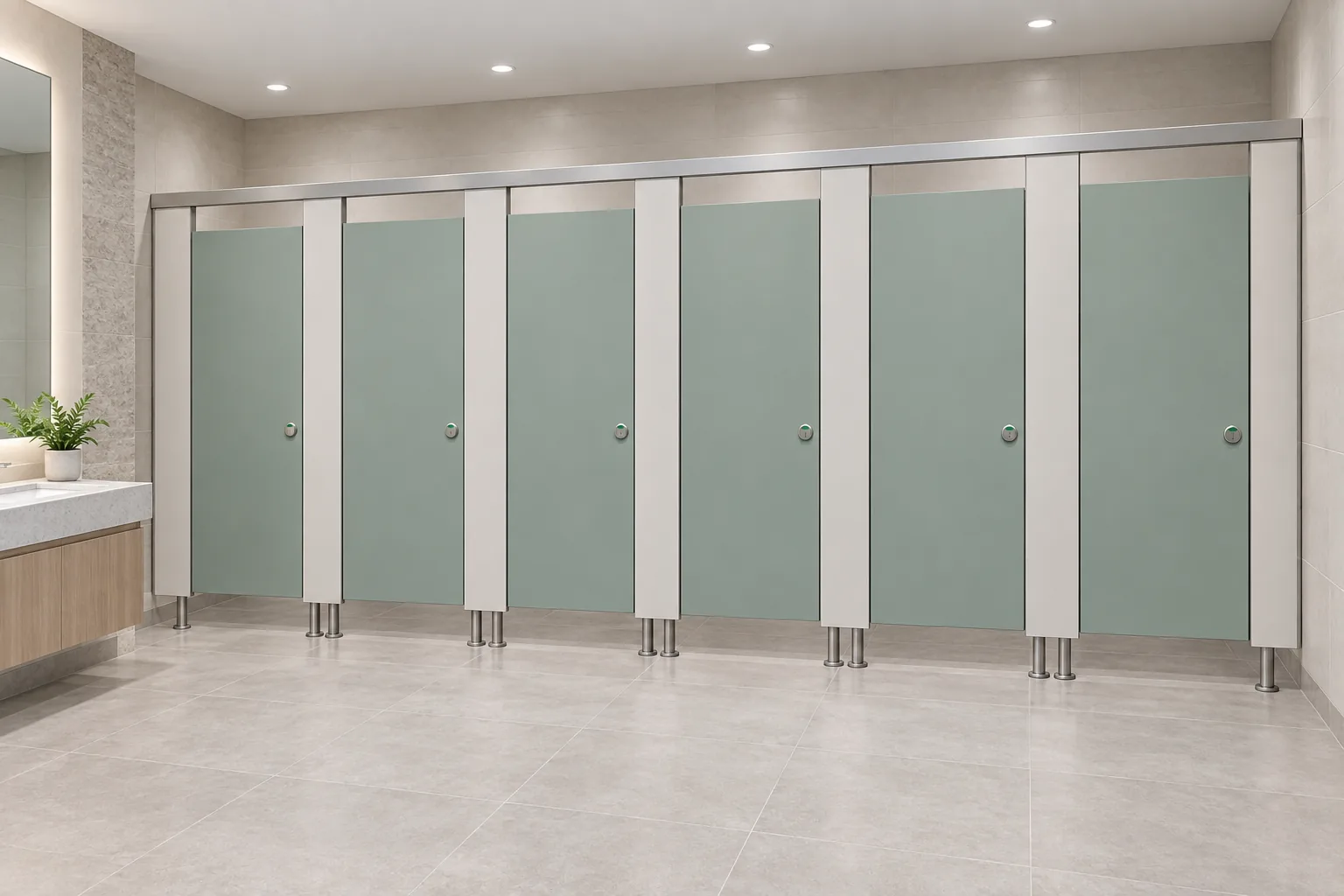
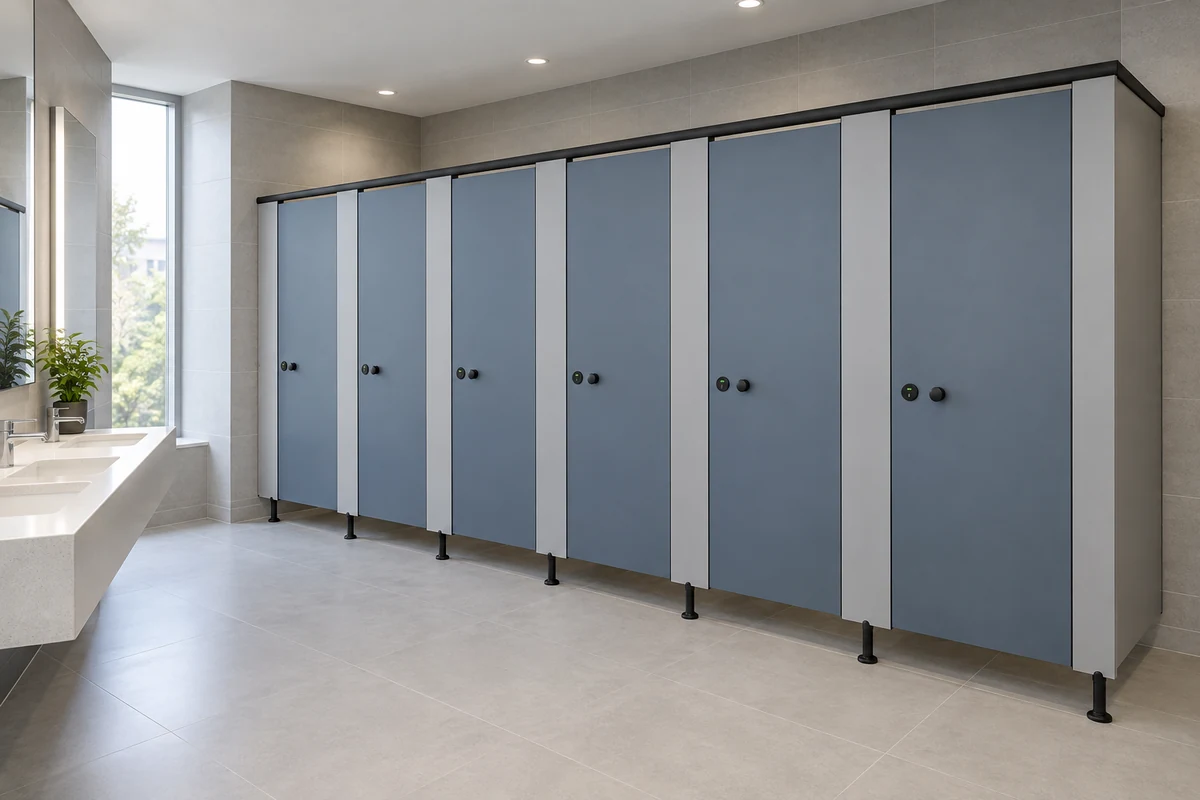
A BIM model can show geometry, location and coordination intent. It cannot prove that a product will perform in a given building. Illustrations show generic design references, not completed EBUNGE customer projects.
Treat the model as a coordination tool. Treat product data as a separate evidence stream. When the two disagree, the project team should resolve the difference through approved technical evidence rather than through an assumption drawn from an illustration.
Evidence note: separate coordination from confirmation
Coordination confirms that objects fit in the model. Confirmation that a material, hardware item, dimension, finish, mounting or rating is suitable for the project requires matching approved technical evidence. A clash-free model is not a substitute for that evidence.
A Six-Step Clash Detection Process
The following sequence keeps the review structured and repeatable. It is a planning framework, not a drawing rule.
- Define the hardware zone. Agree which model elements belong to the partition hardware review and which belong to other disciplines.
- Set the review volume. Identify the space around doors, latches and support interfaces that the team will examine.
- Federate and run the check. Combine relevant models and run the clash routine agreed by the project team.
- Classify each result. Separate genuine conflicts from acceptable proximity and from items needing a design decision.
- Assign an owner. Give every open item a responsible discipline and a target review date.
- Record the outcome. Log decisions, assumptions and unresolved items so the next review starts from a known position.
Coordination Checklist for Project Teams
Use this checklist to prepare for a hardware zone review. It supports Toilet Partition coordination without replacing project-specific evidence.
- Confirm the current model version and the disciplines included.
- Confirm that door operation has been reviewed against adjacent walls and services.
- Confirm that support interfaces are shown consistently across disciplines.
- Confirm that cleaning access and maintenance routes have been considered.
- Confirm that privacy expectations have been discussed with the owner or operator.
- Confirm that applicable local requirements have been identified by the responsible party.
- Confirm that any project-specific material, hardware, dimension, finish, mounting or rating is backed by matching approved technical evidence.
Common Clash Sources Around Hardware
Most hardware zone conflicts fall into a few recurring categories. The project team should confirm project-specific requirements against the relevant approved technical evidence.
| Clash source | Typical coordination question | Evidence needed |
|---|---|---|
| Door swing | Does the door path intersect adjacent fixtures or services? | Reviewed layout and door operation intent |
| Support interface | Is the support condition shown consistently? | Approved interface details |
| Services | Do pipes, ducts or conduits enter the hardware zone? | Coordinated services model |
| Cleaning access | Can the area be reached for routine cleaning? | Cleaning documentation and operator input |
| Adjacent finishes | Do finishes create a conflict at the interface? | Project finish schedule |
The table is a discussion aid. It does not confirm any product characteristic or project outcome.
Specification Language and Evidence Boundaries
Specification text should describe what the project requires, not what a generic product is assumed to provide. A toilet partition hardware BIM clash detection specification should point to the evidence that will confirm each requirement.
Where a requirement depends on a project-specific material, hardware item, dimension, finish, mounting or rating, the specification should state that matching approved technical evidence is required.
Reviewing door operation and privacy
Door operation and privacy are design topics that the project team should review together. The model can show a door swing, but it cannot decide whether the resulting privacy is acceptable for the operator. That decision belongs to the owner, architect and operator, supported by the applicable local requirements identified for the project.
Reviewing support interfaces and cleaning documentation
Support interfaces should be reviewed across disciplines so that no assumption is hidden in a single model. Cleaning documentation should be reviewed with the people who will maintain the space.
How to Use EBUNGE Resources in a Review
Start with the EBUNGE product overview to understand the commercial Toilet Partition / Toilet Cubicle category. Use the resources section for general guidance, and treat every illustration as a generic design reference rather than a application reference record.
When a project-specific question arises, move it to the evidence track. Do not resolve it by inference from a drawing or a photograph.
Frequently Asked Questions
What is toilet partition hardware BIM clash detection?
It is a coordination review that checks whether partition hardware zones conflict with other building elements in a federated model.
Which project information is required before the review?
The team needs current model versions, the disciplines included, the agreed review volume, and the project requirements for layouts, privacy, door operation, support interfaces and cleaning access.
Can a clash-free model confirm that a product is suitable?
No. A clash-free model only shows that objects fit within the reviewed volume. Suitability for a project-specific material, hardware item, dimension, finish, mounting or rating requires matching approved technical evidence.
How should the team handle unresolved clashes?
Assign each open item to a responsible discipline, record the decision needed, and carry it into the next review. Unresolved items should remain visible rather than being closed by assumption.
Do illustrations show real EBUNGE projects?
No. Illustrations show generic design references, not completed EBUNGE customer projects.
When should the project team contact EBUNGE?
Contact EBUNGE when the project needs product category information or a discussion about project-specific evidence requirements. Use the contact page to start that conversation.
Conclusion
Define the hardware zone, run the review, classify the results, and keep every project-specific claim on an evidence track.
For product category context, review the EBUNGE product range. For general guidance, visit the resources library. To discuss a project, contact the EBUNGE team.