
How Architects Track Revisions to Toilet Partition Hardware Decisions
Quick project answer
Toilet partition hardware decisions are rarely settled in a single meeting. They accumulate across concept layouts, tender drawings, shop drawings and construction issues. Each revision can quietly change a hinge type, a support condition or a door swing without anyone recording why. For architects and project teams, the real risk is not one wrong choice but an untraceable chain of small changes. This article sets out an evidence-bounded framework for tracking those decisions across revisions, so that every hardware choice remains connected to approved project information.
Why Hardware Decisions Drift Across Revisions
Hardware drift usually starts with a reasonable local adjustment. A door swing changes to avoid a duct. A support interface moves because a wall build-up changes. A cleaning access point is relocated after a services coordination meeting. Individually, these edits look minor. Collectively, they can leave the hardware schedule describing a condition that no longer exists on the latest layout.
The problem is compounded when revisions are tracked by drawing number alone. A drawing can be current while the hardware decision behind it is stale. Without a decision log that links each hardware item to a specific revision, project teams lose the ability to explain why a component was selected or whether it still suits the current layout.
What Counts as a Hardware Decision Record
A useful record is not a product catalogue entry. It is a short, project-specific statement that connects a hardware item to the layout condition it serves. At minimum, it should identify the cubicle or door it relates to, the revision in which the condition was confirmed, and the evidence source that supports the selection.
Because EBUNGE product category includes commercial Toilet Partition / Toilet Cubicle, hardware decisions sit within that broader partition scope. The record should stay within confirmed project facts and avoid inferring hidden construction from generic illustrations.
Core fields for a decision log
- Door or cubicle reference and drawing sheet number
- Revision number and issue date when the condition was confirmed
- Hardware item description as specified, without inferred performance
- Support interface condition shown on the current layout
- Evidence reference for any project-specific material, dimension or mounting
- Reviewer name and date of last check
A Revision Tracking Process for Project Teams
The following sequence keeps hardware decisions visible without turning the review into a compliance claim. It is a coordination method, not a certification route.
- Baseline the layout. Confirm the current cubicle layout, door operation and support interfaces before reviewing hardware.
- List open hardware items. Record every item that is not yet matched to approved technical evidence.
- Map each item to a revision. Note the drawing issue in which the supporting condition was last confirmed.
- Flag changed conditions. The project team should confirm project-specific requirements against the relevant approved technical evidence.
- Review privacy and door operation. Confirm that sightlines, clearance and door swing remain consistent with the current layout.
- Check cleaning documentation.
- Close with a signed revision note. Record what was reviewed, what remains open and which evidence is still required.
Coordinating Hardware Decisions with the Wider Project Team
Hardware decisions do not belong to one discipline. Architects, interior designers, contractors and owners each hold part of the picture.
Contractors need to know which support interfaces are confirmed. Designers need to know which door operations are still open. Owners need a clear view of what remains unresolved. A single shared log, reviewed at each revision, reduces the chance that a hardware item is ordered against an outdated condition.
Evidence note: what must not be assumed
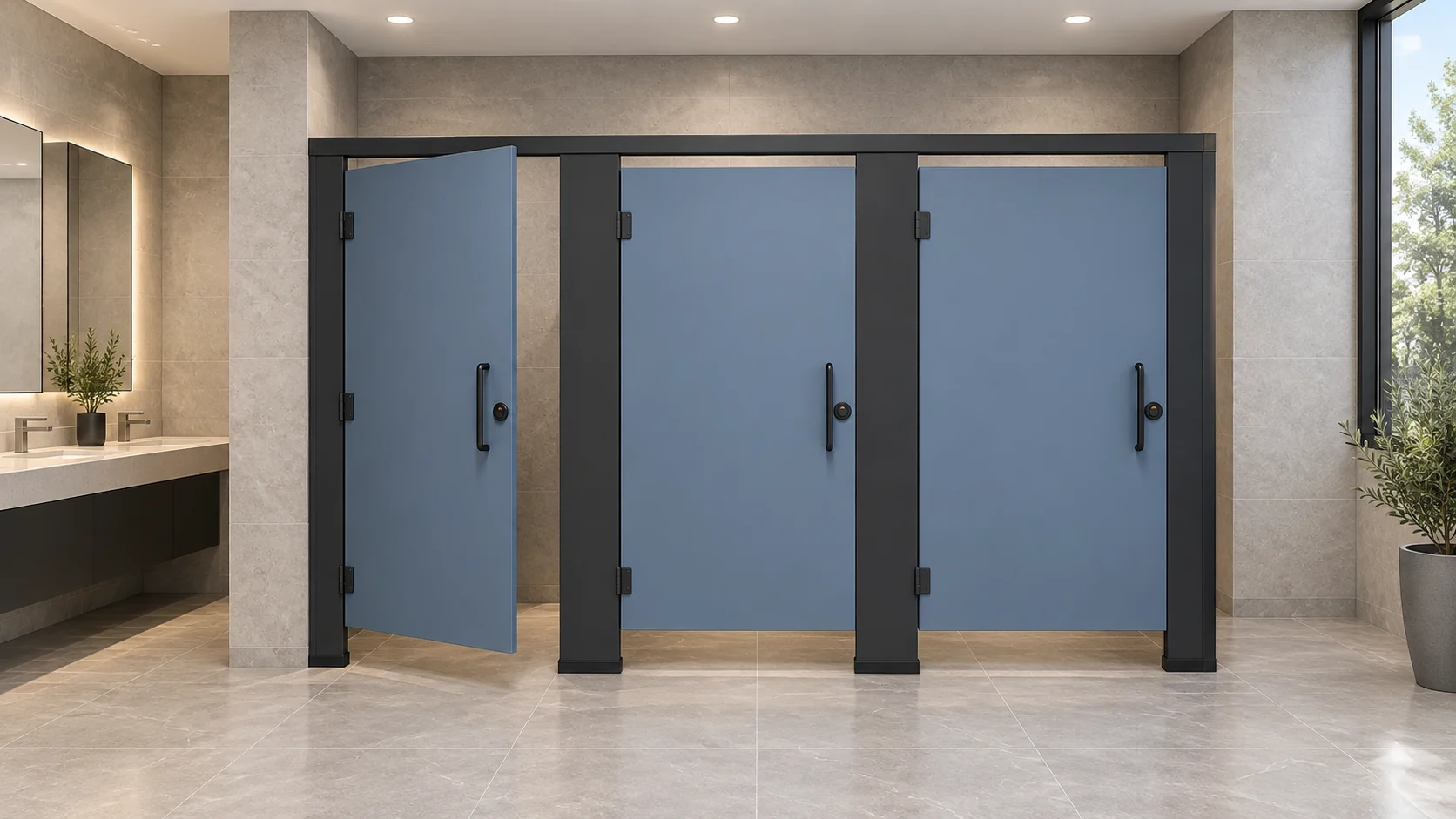
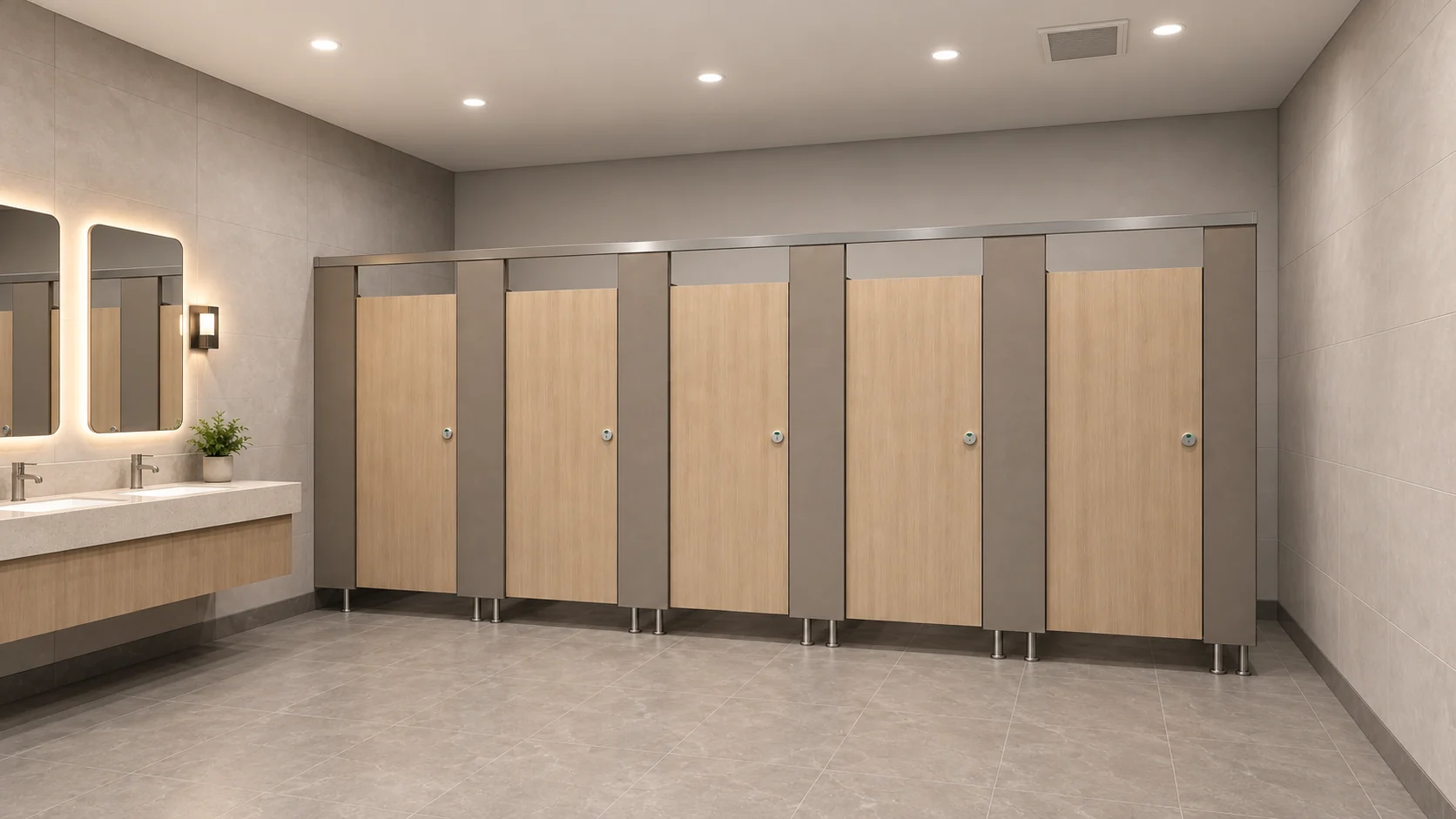
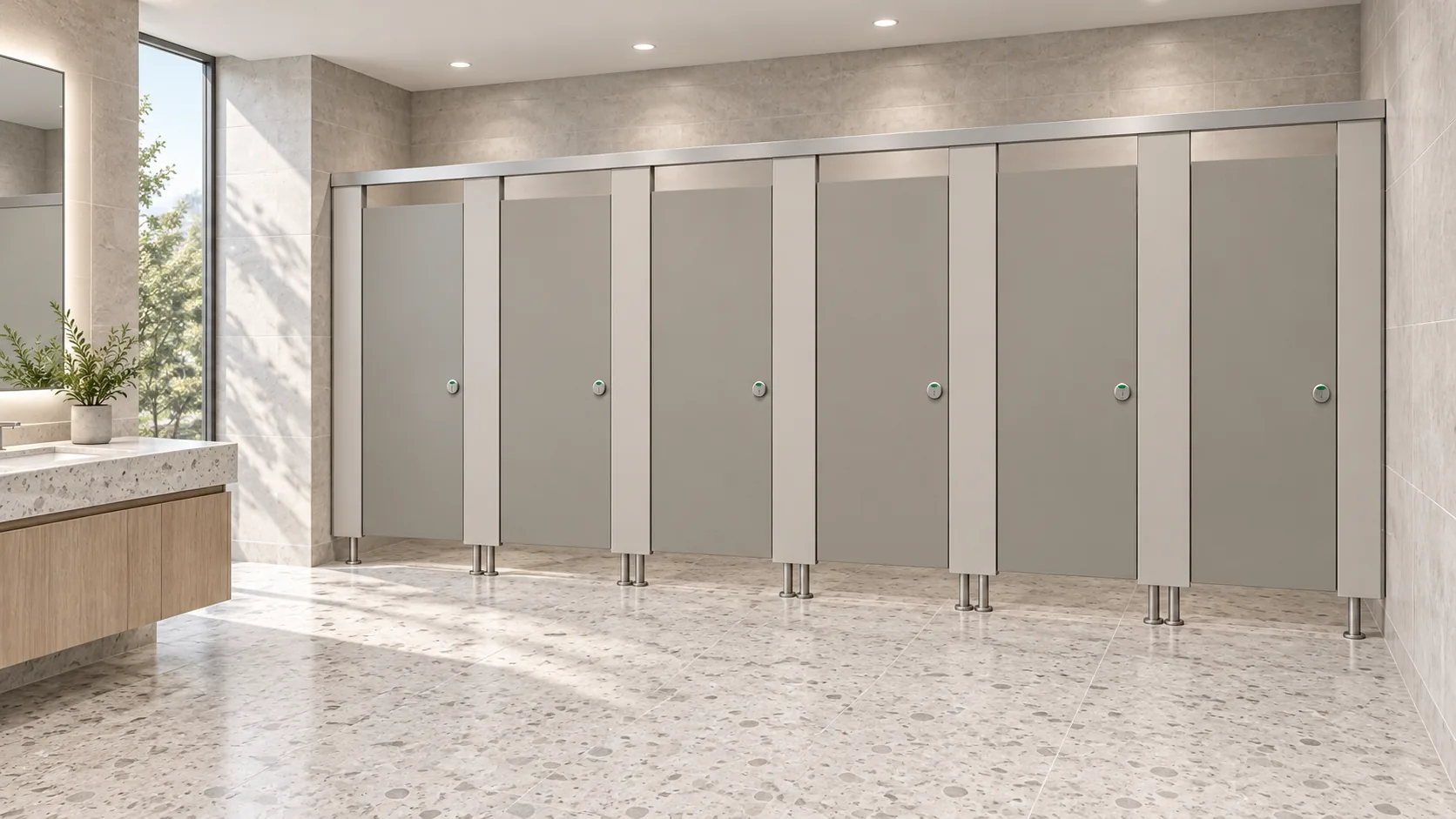
Any project-specific material, hardware, dimension, finish, mounting or rating requires matching approved technical evidence. Illustrations show generic design references, not completed EBUNGE customer projects. Do not treat HPL, compact laminate, phenolic or stainless steel as interchangeable, and do not infer hidden construction from illustrations.
Common Revision Traps and How to Avoid Them
Most tracking failures come from a small set of recurring habits. Recognising them early keeps the hardware schedule aligned with the latest layout.
| Revision trap | Why it causes drift | Practical countermeasure |
|---|---|---|
| Updating the drawing but not the log | Hardware schedule describes an old condition | Make log update part of the drawing issue checklist |
| Using generic illustrations as evidence | Hidden construction may be inferred incorrectly | Require project-specific evidence for each item |
| Treating materials as interchangeable | Substitution changes interfaces and fixing conditions | Record material as a separate decision with its own evidence |
| Leaving door operation open | Privacy and clearance reviews cannot be completed | Close door operation before hardware sign-off |
Reviewing Privacy, Door Operation and Support Interfaces
These three areas are where hardware decisions most often interact with layout changes. Privacy depends on sightlines and door gaps as shown on the current drawing. Door operation depends on swing, clearance and the surrounding fixtures. Support interfaces depend on the wall or frame condition that the partition connects to.
None of these can be confirmed from a generic illustration. Each requires the project team to review the current layout and record the condition that the hardware decision assumes. Where a condition is not yet confirmed, the hardware item should remain open rather than being treated as settled.
Documentation and Local Requirements
Project teams should describe applicable local requirements as part of the review record without asserting unverified compliance. The decision log can note which requirements were considered, who reviewed them and what evidence was requested. It should not state that a project complies unless that conclusion is supported by approved project-specific evidence.
Cleaning documentation follows the same principle. Record the access and maintenance assumptions that informed the hardware decision, and keep them linked to the revision in which they were confirmed.
Frequently Asked Questions
What is the minimum information needed to track a toilet partition hardware decision?
At minimum, record the door or cubicle reference, the drawing revision in which the condition was confirmed, the hardware item as specified, the support interface condition and the evidence source. Without these fields, the decision cannot be traced back to a specific layout state.
Can a hardware decision be closed without project-specific evidence?
No. Any project-specific material, hardware, dimension, finish, mounting or rating requires matching approved technical evidence. If that evidence is not available, the item should remain open in the decision log.
How often should the hardware decision log be updated?
Updating only at major milestones allows small changes to accumulate without review.
Do generic illustrations count as evidence for hardware selection?
No. Illustrations show generic design references, not completed EBUNGE customer projects.
How should the team handle a layout change after hardware is specified?
Flag every linked hardware item for re-check, confirm whether the support interface and door operation still match the new layout, and record the outcome against the new revision. Do not assume the previous decision remains valid.
Where can project teams find maintained product context?
Review the maintained product category information on the EBUNGE products page and use the resources section for general guidance. Project-specific configurations still require their own approved evidence.
Conclusion: Keep Every Hardware Decision Traceable
Tracking toilet partition hardware decisions across revisions is a documentation discipline, not a product claim. The goal is to ensure that every hardware item remains connected to the layout condition it was chosen for, and that any change in that condition triggers a review. By maintaining a shared decision log, recording evidence sources and keeping unconfirmed items open, project teams reduce the risk of ordering or installing against an outdated drawing.
EBUNGE product category includes commercial Toilet Partition / Toilet Cubicle. For project teams ready to discuss their layout and evidence requirements, contact the EBUNGE team to begin a project-specific review.