
Circulation Review Before Finalizing Toilet Partition Hardware Layouts
Quick project answer
A toilet partition hardware circulation review is the point where a project team stops treating the washroom as a set of isolated cubicles and starts reading it as one coordinated system. Door swings, approach space, support interfaces, cleaning routes and local requirements all meet at this stage. The review does not prove compliance, and it does not replace approved technical evidence. It simply exposes assumptions before layouts are frozen.
Why Circulation Review Belongs Before Layout Finalization
Hardware layouts are often finalized late, after finishes and sanitary ware have been positioned. That sequence may create rework. The project team should confirm project-specific requirements against the relevant approved technical evidence.
A circulation review is a coordination exercise. It asks whether people, doors, cleaning equipment and maintenance access can share the same footprint without conflict. It does not certify that a layout is compliant, and it does not confirm a material, hardware type, dimension or rating. Those items require matching approved technical evidence for the specific project.
What the Project Team Should Bring to the Review
The quality of a circulation review depends on the documents in the room. A marked-up plan alone is rarely enough. The team should be able to see the relationship between the cubicle envelope, the door leaf, the approach zone and the surrounding washroom elements.
- Current architectural plan showing cubicle positions and adjacent fixtures.
- Door operation intent for each cubicle, including the direction of travel.
- Support interface locations where partitions meet walls, floors or structural elements.
- Cleaning and maintenance access routes, including equipment turning space.
- Applicable local requirements identified by the project team, not assumed by the supplier.
- Any approved technical evidence already issued for the project.
Where a document is missing, the review should record it as an open item rather than fill the gap with an assumption. This is especially important for material, hardware, dimension, finish, mounting and rating decisions, which must be matched to approved evidence.
A Step-by-Step Circulation Review Process
The following sequence keeps the discussion structured and prevents one issue from being resolved at the expense of another.
- Confirm the review scope and the documents being used.
- Walk the approach route from the washroom entrance to each cubicle.
- Check door operation against the approach route and adjacent cubicles.
- Review privacy from the user position, not only from the plan.
- Trace support interfaces and note any unresolved coordination points.
- Test the cleaning and maintenance route with the intended equipment.
- List local requirements raised by the project team and their evidence status.
- Record open items, owners and the next review date.
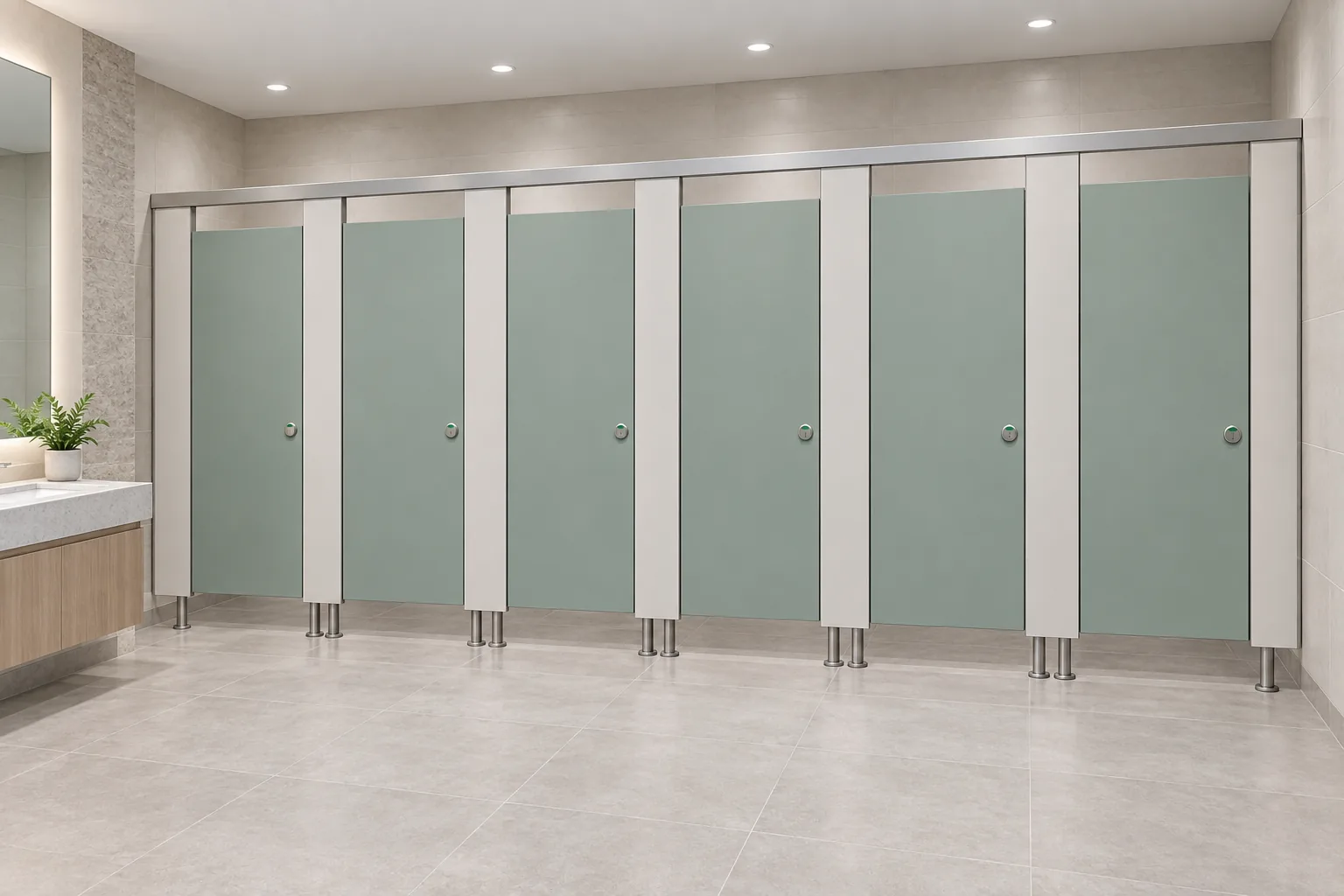
Steps three to six are where most layout changes surface. A door that conflicts with a neighbouring door, a privacy line that reads differently in elevation, or a support interface that clashes with a service zone should be resolved before hardware layouts are issued for fabrication.
Door Operation, Privacy and Support Interfaces
Door operation
Door operation is a circulation issue before it is a hardware issue. The team should confirm how each door is intended to move, what it swings toward, and whether that movement interferes with someone standing at an adjacent cubicle. The review should not assume a specific hinge, closer or latch type unless approved evidence supports it.
Privacy
Privacy is reviewed from the user’s viewpoint. Sightlines at the door edge, the relationship between adjacent cubicles and the height of surrounding elements all affect the experience. The review can identify where privacy needs further design attention, but it cannot claim a privacy rating without project-specific evidence.
Support interfaces
Support interfaces are the connections between the partition system and the building. The team should confirm that wall, floor and structural conditions are coordinated with the partition layout. Where a condition is unknown, it should be flagged for survey rather than resolved by assumption.
Cleaning Documentation and Maintenance Access
Cleaning documentation is often treated as an afterthought, yet it shapes circulation. The review should confirm that cleaning equipment can reach every cubicle, that doors can be held or secured during cleaning, and that maintenance access to hardware is not blocked by adjacent elements.
The project team should also agree what cleaning information will be handed over and who will maintain it. This is a documentation and coordination point, not a performance claim. No antimicrobial, waterproof or service-life conclusion should be drawn from the review itself.
Evidence Boundaries and Local Requirements
Every circulation review should end with a clear statement of what has been confirmed and what remains open. The table below is a useful way to separate the two.
| Review item | What the review can do | What still needs evidence |
|---|---|---|
| Layout and approach | Identify conflicts and coordination points | Approved project drawings |
| Door operation | Confirm intended movement and clearances | Approved hardware evidence |
| Privacy | Raise sightline concerns | Project-specific design confirmation |
| Support interfaces | Flag unresolved building conditions | Survey and structural coordination |
| Cleaning access | Test route with intended equipment | Maintained cleaning documentation |
| Local requirements | Record items raised by the project team | Applicable local verification |
This table is a coordination tool, not a compliance statement. It helps the team see where a decision depends on evidence that has not yet been issued. For product category context, the EBUNGE toilet partition range can be reviewed alongside the project’s own approved documents.
Common Coordination Gaps to Close Early
Most circulation problems are predictable. They appear when the review is treated as a formality rather than a working session.
- Door swing shown on plan but not checked against the approach route.
- Privacy reviewed only in plan, not in elevation or from the user position.
- Support interfaces left to the installation phase without a survey.
- Cleaning equipment assumed to fit without testing the turning space.
- Local requirements mentioned verbally but not recorded with an evidence owner.
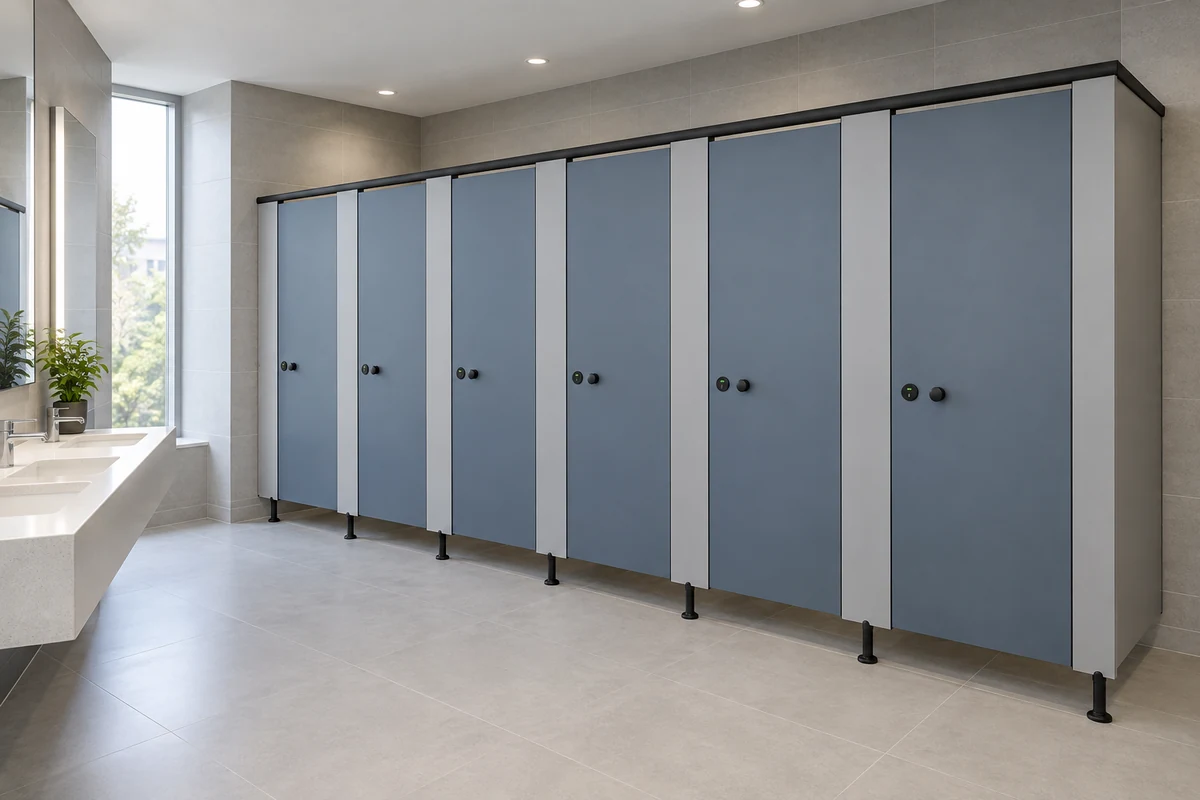
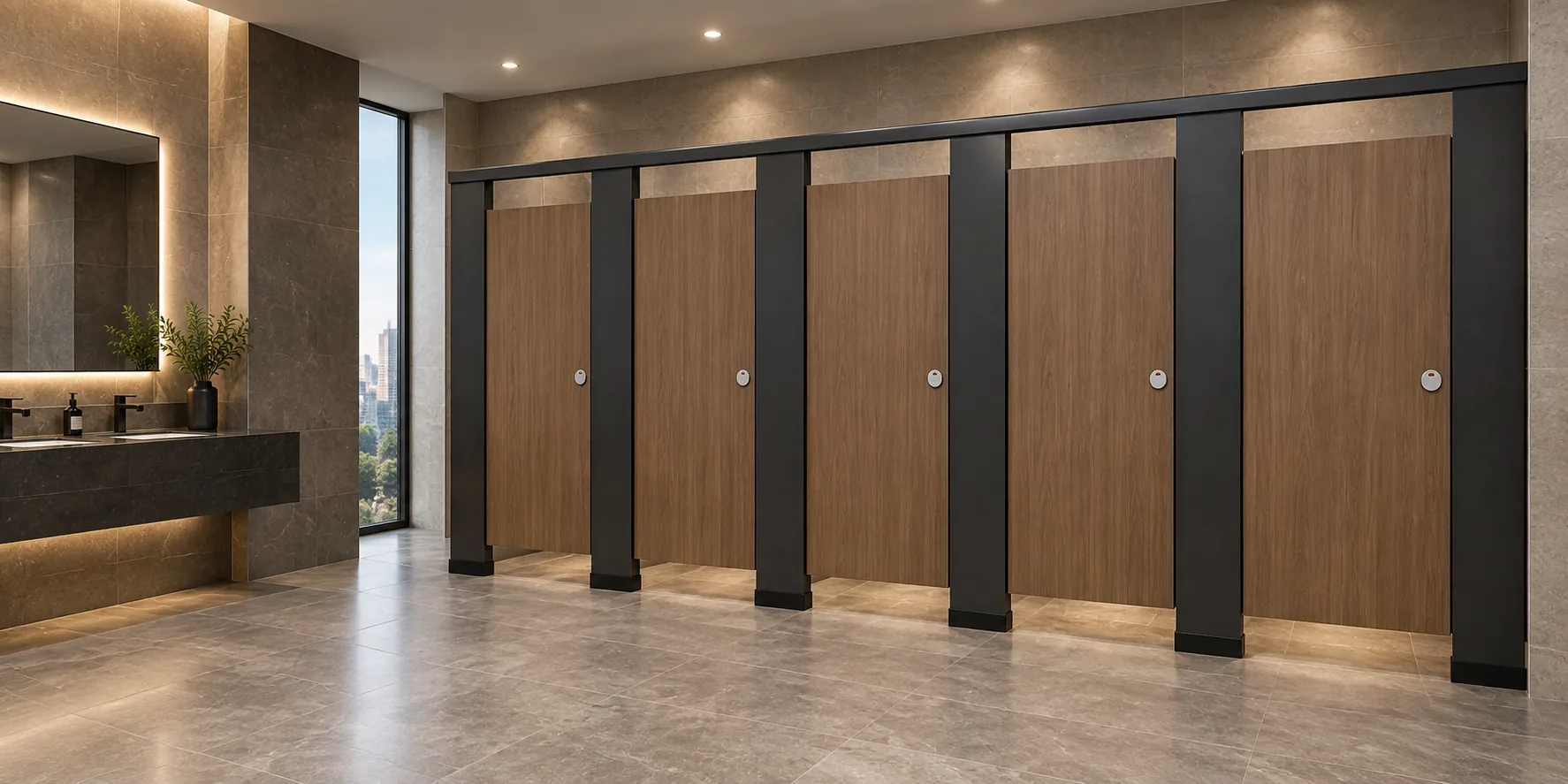
- Illustrations treated as application reference references rather than generic design references.
Closing these gaps early reduces the risk of late changes. It also gives the project team a clearer basis for requesting the technical evidence it needs. .
Frequently Asked Questions
What is a toilet partition hardware circulation review?
It is a project-team review of how people, doors, cleaning equipment and maintenance access move around and through the cubicle layout before hardware layouts are finalized. It identifies coordination issues; it does not certify compliance or confirm product performance.
Does the review confirm that a layout is compliant?
No. The review records items raised by the project team and the applicable local requirements they identify. Compliance depends on project-specific verification, not on the circulation review itself.
Can the review confirm a material, hardware type or dimension?
No. Any project-specific material, hardware, dimension, finish, mounting or rating requires matching approved technical evidence. The review can only note where that evidence is needed.
How should privacy be assessed during the review?
Privacy should be assessed from the user’s position, including sightlines at the door edge and the relationship between adjacent cubicles. The review can raise concerns, but it cannot claim a privacy rating without project-specific evidence.
What role does cleaning documentation play?
Cleaning documentation supports the circulation review by confirming that equipment can reach each cubicle and that maintenance access is not blocked. It is a coordination input, not a performance claim.
Are the illustrations completed EBUNGE projects?
No. Illustrations show generic design references, not completed EBUNGE customer projects. They should not be used to infer hidden construction, material composition or performance.
Conclusion and Next Step
It brings door operation, privacy, support interfaces, cleaning access and local requirements into one discussion, and it records what still needs approved evidence. That discipline protects the project from late changes and unsupported assumptions.
To discuss your project’s circulation review and the evidence your team needs, contact EBUNGE with your drawings and open items. The team can review the product category context, but project-specific material, hardware, dimension, finish, mounting and rating decisions will still require matching approved technical evidence.