
Tender Addenda Review for Toilet Partition Hardware Scope Changes
Quick answer: toilet partition
A toilet partition tender addenda can arrive late in procurement and quietly change hardware scope, fixing methods or interface expectations. For overseas contractors, architects, interior designers, owners and renovation teams, the risk is not the addendum itself but treating it as a general product fact.
This guide sets out an evidence-bounded review process for toilet partition tender addenda so project teams can separate confirmed information from items that still require approved technical evidence.
Why Hardware Scope Changes Deserve a Structured Review
Hardware scope in a toilet cubicle package touches door operation, support interfaces, cleaning routines and the way panels meet adjacent construction. When an addendum changes hinges, latches, indicators, foot assemblies or fixing references, the change may look small on paper but affect coordination across trades.
The confirmed product fact for this topic is narrow: EBUNGE product category includes commercial Toilet Partition / Toilet Cubicle. The project team should confirm project-specific requirements against the relevant approved technical evidence.
What a Tender Addendum Typically Changes
Addenda are issued for many reasons: a revised drawing, a clarification requested during tender queries, a change in the base build interface, or a correction to a schedule. In toilet partition packages, hardware-related addenda often appear because the door swing, privacy expectation or cleaning access has been reconsidered.
Common addendum triggers
- Revised door operation or handing shown on an architectural drawing.
- Updated support interface where the partition meets wall, floor or ceiling construction.
- Clarified cleaning access around cubicle entrances and circulation.
- Changed hardware schedule referencing a different item or finish.
- Local requirement updates that the project team must verify separately.
None of these triggers automatically confirms a product configuration. Each one creates a question that the project team should route to the correct evidence holder before pricing or fabrication proceeds.
A Six-Step Review Process for Project Teams
The following numbered process is a coordination aid, not a compliance statement. It helps teams avoid treating an addendum as a general product fact.
- Log the addendum. Record the issue date, revision number and the clause or drawing it affects.
- Identify the scope change. State plainly whether the change concerns layout, privacy, door operation, support interface, cleaning documentation or a local requirement.
- Separate fact from assumption. Mark any statement that requires project-specific material, hardware, dimension, finish, mounting or rating evidence.
- Request matching evidence. Ask the responsible party for the approved technical document that supports the changed item.
- Check interfaces. Confirm how the change interacts with adjacent trades, structural openings and finishing sequences.
- Reissue the coordinated response. Circulate the clarified position to all tenderers on the same revision so comparisons remain fair.
Evidence Boundaries When Reading Addenda
An addendum is a commercial and coordination document. It is not, by itself, proof of performance.
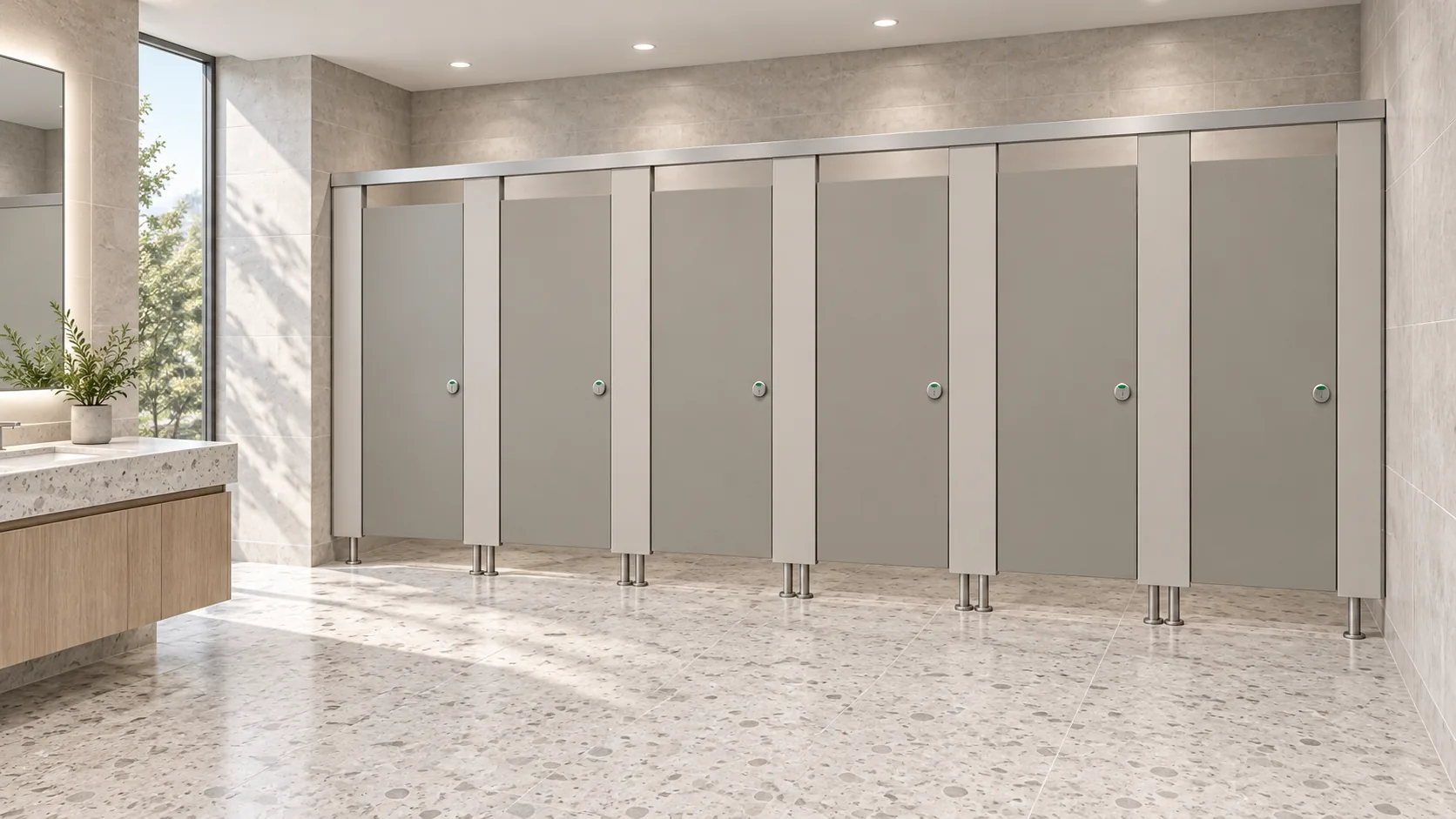
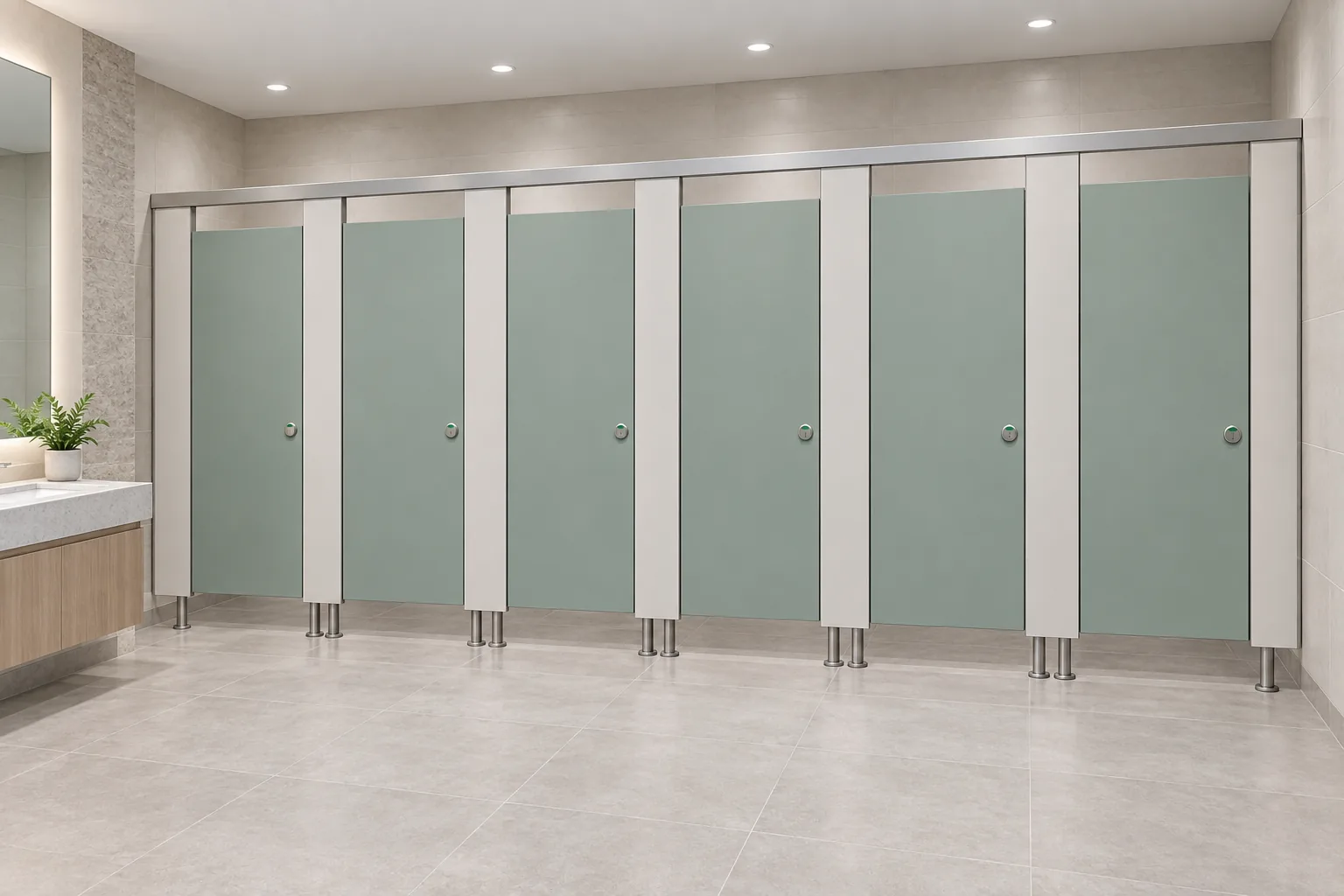
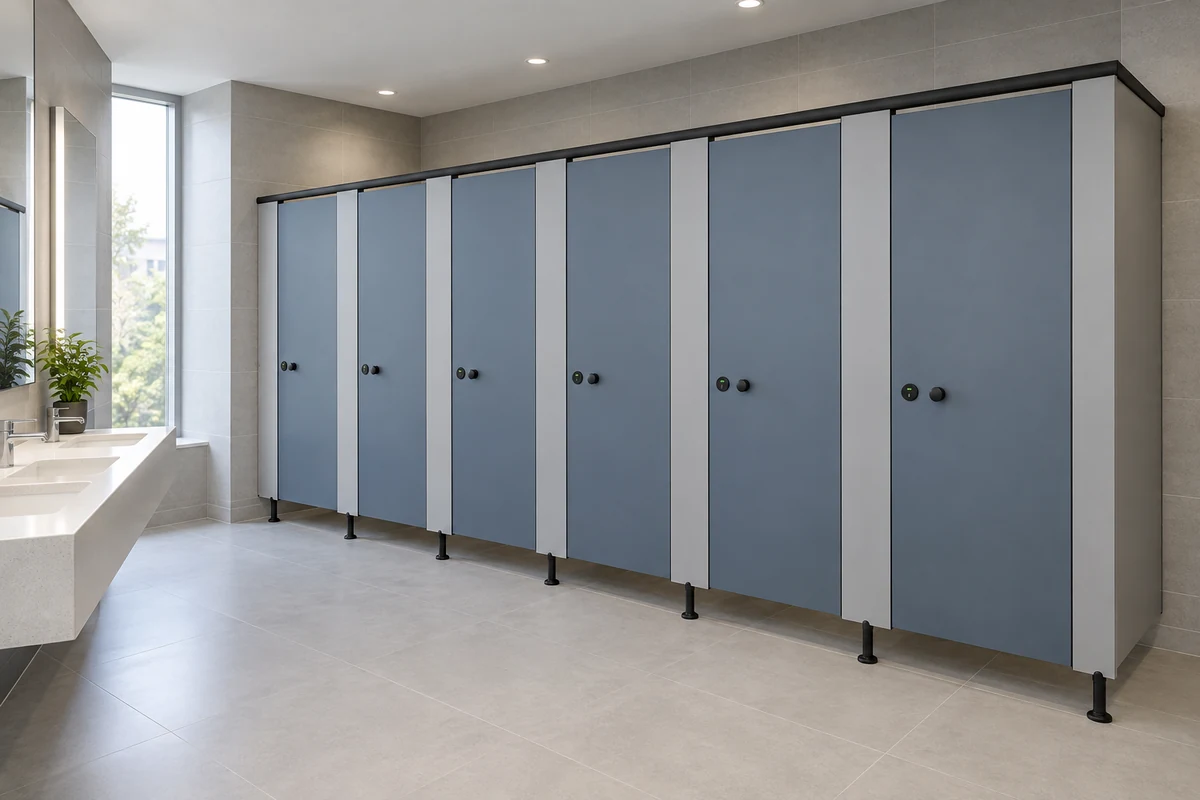
Evidence note: any project-specific material, hardware, dimension, finish, mounting or rating requires matching approved technical evidence. Illustrations show generic design references, not completed EBUNGE customer projects.
Teams should also avoid treating HPL, compact laminate, phenolic or stainless steel as interchangeable. They are different material families with different documentation paths, and an addendum that swaps one reference for another should trigger a fresh evidence check rather than an assumption of equivalence.
Coordination Points Beyond the Hardware Schedule
Hardware scope rarely stands alone. A change to door operation can affect privacy review, cleaning access and the sequence in which cubicles are installed. A change to support interfaces can affect how the partition package meets the base build.
Questions to route to the right reviewer
- Does the addendum change the layout or only the hardware description?
- Has privacy been reviewed against the project’s own criteria?
- Does door operation still suit the intended user group and cleaning routine?
- Are support interfaces coordinated with structural and finishing trades?
- Is cleaning documentation still consistent with the revised arrangement?
- Have applicable local requirements been checked by the responsible party?
These questions describe project-team review. They do not assert compliance with any code, standard or authority requirement.
Comparing Addendum Items Without Inventing Facts
The table below is a review aid. It shows how to classify addendum lines by evidence status rather than by assumed performance.
| Addendum line | Evidence status | Next action |
|---|---|---|
| Hardware item renamed | Unconfirmed for this project | Request approved technical evidence |
| Door handing revised | Drawing-dependent | Confirm against current architectural drawing |
| Support interface noted | Coordination item | Check with structural and finishing trades |
| Local requirement cited | Jurisdiction-specific | Route to the responsible local reviewer |
| Cleaning access mentioned | Operational item | Review with facilities or cleaning team |
For maintained product context, teams can review the EBUNGE product category and the resource library. Project-specific configuration still requires confirmation through the appropriate channel.
Documentation Habits That Reduce Addendum Risk
Keep a single addendum register, cross-reference each change to the clause it modifies, and note the evidence owner for every open item. Where a change affects a schedule, update the schedule rather than adding a separate note that may be missed.
Teams should also keep generic design references clearly labelled. A layout illustration can help a discussion about circulation or privacy, but it does not confirm a material, a fixing method or a application reference. That distinction protects both the specifier and the supplier.
Frequently Asked Questions
What is a toilet partition tender addendum?
It is a formal change or clarification issued during the tender period that modifies part of the original enquiry, such as a drawing, schedule or hardware reference. It should be logged and reviewed like any other tender document.
Does an addendum confirm product performance?
No. An addendum is a coordination and commercial document.
How should teams handle a hardware substitution in an addendum?
Treat it as a new evidence requirement. Do not assume that different material families or hardware items are interchangeable without approved documentation.
Can generic illustrations be used in a tender response?
They can support discussion, but they should be labelled as generic design references. They do not represent completed EBUNGE customer projects or confirmed configurations.
Who should review local requirements?
The responsible local reviewer or authority having jurisdiction. The project team should describe the review process without asserting unverified compliance.
When should a supplier be contacted?
Contact the supplier when an addendum raises a project-specific question about material, hardware, dimension, finish, mounting or rating that cannot be resolved from approved evidence already held.
Conclusion and Next Step
A disciplined toilet partition tender addenda review keeps hardware scope changes visible, separates confirmed facts from open questions, and prevents generic references from being read as project commitments. Use the process above, keep evidence boundaries explicit, and route unresolved items to the right reviewer.
To discuss a project-specific enquiry, contact the EBUNGE team with the relevant addendum reference and drawing context.